

Xenoverse origins / R-062
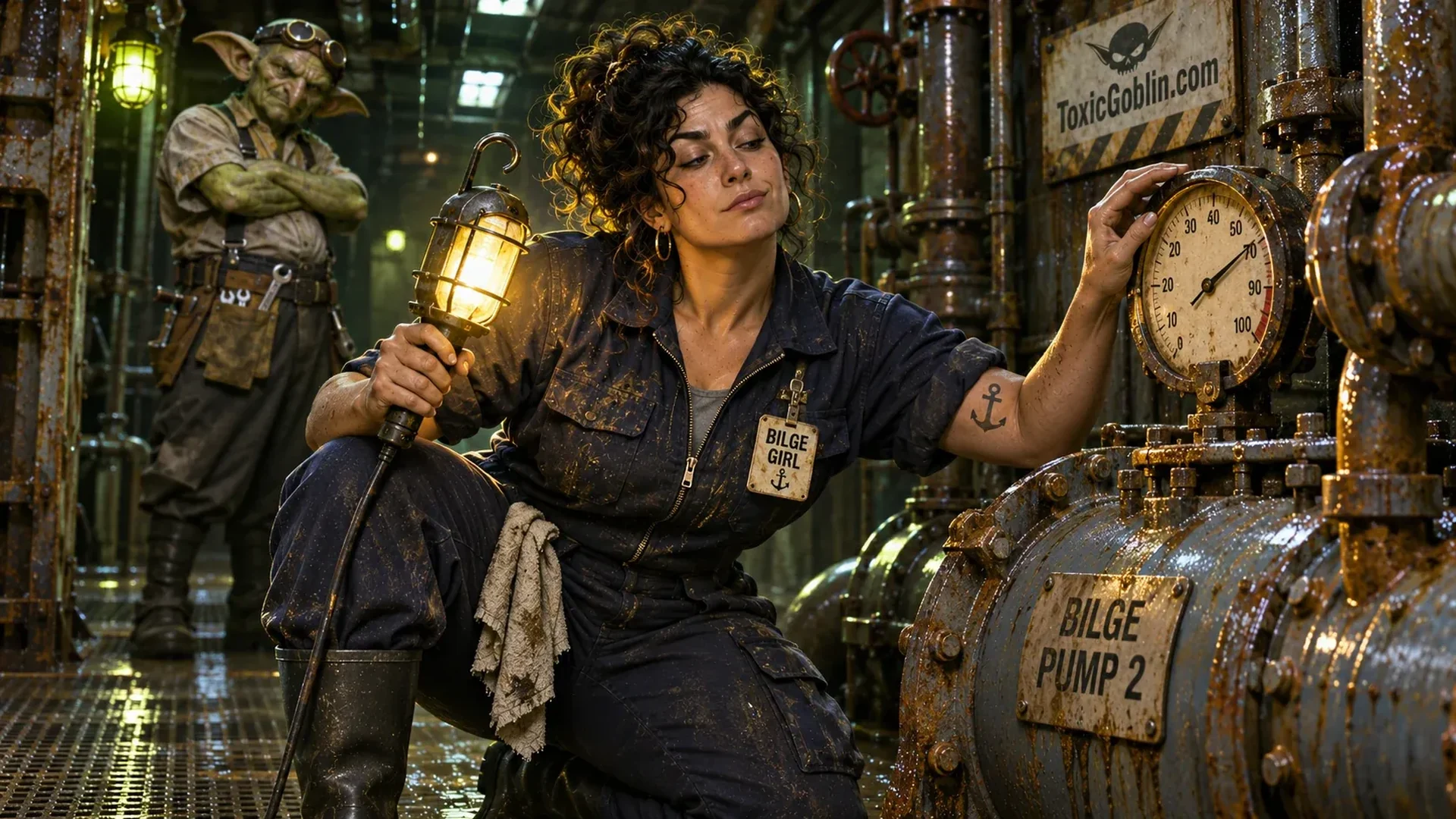
Billie BilgeOrigin story
Billie Bilge: A Shore beneath the Floor
A solitary inspector must give up a cherished private refuge to separate her ship from a shoreline trapped in its bilge.
Read the origin ↓
Billie Bilge found a seashell balanced on the inspection gauge. The ship had crossed no beach, and the shell was warm from sunlight the compartment had never seen.
Water below the ship begins keeping the tide of a harbour that no longer appears on any map.
She held it to her ear. Instead of the sea, she heard a man asking whether the last boat had arrived. Behind his voice, a harbour bell rang from a place Billie had deliberately stopped visiting.
This one won't fit your boxes.
From the dossier
Prologue — The Water Has an Appointment
As Bilge Water Inspector at the Cruise outpost, Billie trusted patterns more than explanations. A stain showed where something had been. A tide mark showed where it expected to return. An explanation usually showed who hoped to leave first.
The Goblin Council respected her measurements and disliked the silence in which she delivered them. Its maritime clerk addressed every inspection request to Billie personally, convinced that familiarity might eventually produce conversation. She knew him as the official who called every unexplained leak an opportunity for further observation.
This water was not leaking. It was arriving.
It rose along the wall, stopped at a mark shaped like a harbour step, then withdrew without entering any drain. A scatter of warm sand remained. Billie pressed a boot beside it and found the impression already waiting beneath her sole.
She recognised the sand. There was a cove beyond the mapped harbours where she went when she wanted nobody to know what she was thinking. She had never recorded it in Council service notes. Some things, she believed, could belong to her without being made useful.
Now the cove's shell sat on the ship's gauge.
The voice inside it asked again about the last boat.
Billie could have called the maritime clerk. Instead, she told her assistant to keep passengers away from the service stairs while she took another reading.
It was not quite a lie. She intended to read the shoreline herself, without giving anyone else its name.
Act 1
The Harbour in a Sample Jar
Act I — The Harbour in a Sample Jar
The next arrival brought a miniature pier. It unfolded in a sample jar while Billie watched, each wet plank settling into place with the sound of a much larger structure. A little lantern swung above a figure too indistinct to identify.
Billie asked the shell where it was. The man answered with the name of a harbour removed from the shipping routes. She remembered it from a weathered sign near her cove. She had assumed the sign marked a place that had simply closed.
“Who is waiting?”
“Everyone who missed the boat.”
The jar darkened. Small shapes gathered along its pier.
Billie carried it to a chart table. The ship's route now crossed a blank stretch of paper where a harbour symbol had been scraped away. As she watched, the blank patch spread toward the pencil line indicating their next destination.
The vessel had taken aboard more than water. Somewhere on its voyage, it had crossed a neglected arrival: a tide that still expected a boat after the harbour had disappeared. Now it was using the ship to complete that appointment.
Her assistant suggested returning the sample.
Billie shook her head. She wanted to understand it first. Understanding had always felt cleaner than involvement. If she could establish a cause, somebody with a more expansive job description could inherit the consequence.
The jar filled with sand. The little pier tilted. Upstairs, a passenger asked why the view through the dining-room windows now included a breakwater.
Billie finally contacted the Council's maritime clerk.
He recognised her voice and said he had been expecting the routine report.
“This one won't fit your boxes.”
“Most things do if you start with the smallest.”
She placed the shell against the speaking tube. The harbour bell rang through his office. For several breaths, he offered no arrangement of boxes at all.
Act 2
A Place Kept off the Chart
Act II — A Place Kept off the Chart
The clerk wanted coordinates. Billie supplied the ship's position. He asked for the other shore.
She hesitated long enough for him to understand that she knew something she had not reported.
“There is a cove,” she said.

“Then put it on the chart.”
It sounded simple because he had never sat there without a badge, listening to water that wanted nothing from him. Billie had guarded that place against exactly this moment: the conversion of refuge into an answer.
Meanwhile, harbour stones appeared beneath the compartment's water. The ship was not sinking. It was becoming land, one remembered step at a time. Passengers watched gull-shaped shadows pass through closed doors. The unseen people on the miniature pier began calling destinations Billie had never heard.
She asked the man in the shell what would make the boat arrive.
“A shore that knows us.”
The vanished harbour had no remaining place to receive its tide. Billie's cove lay beyond its former breakwater, sheltered by the same curve of rock. It could acknowledge what the charts had forgotten.
She could supply the name and hope the Council solved the rest. But the water responded to recognition, not ink. Whenever she described the cove impersonally, the shell grew cold. Whenever she remembered its warm stones, the tide paused to listen.
Her assistant found her kneeling beside the gauge with both hands over the shell.
“Is it valuable?”
“Yes.”
“Does it stay valuable if the ship turns into a staircase?”
Billie almost laughed. Then she gave him the true name of the cove, the one she had used privately rather than the ordinary description on the coast.
The shell became warm again.
She would have to guide an entire missing harbour into the place where she had gone to be alone. There was no measurement that could make the trade less personal.
Act 3
The Last Boat Arrives
Act III — The Last Boat Arrives
Billie spoke into the shell, describing the approach as memory rather than instruction: the black rock shaped like a folded coat, the strip of pale sand, the place where evening light lingered after the rest of the coast grew dim.
The water listened. Across the compartment floor, a little path opened between harbour stones.
The man in the shell asked whether there was room.
Billie looked at her assistant, then at the stairs leading to the crowded decks above.
“There will have to be.”
She set the shell on the lowest impossible step. A boat no longer than her hand approached through the sample jar, passed across its glass without breaking it and entered the shell's narrow opening. Another followed. Then another.
Billie could not see their passengers clearly. She heard bundles being lifted, greetings exchanged, somebody asking after a kettle. Their ordinariness made her more careful. Whatever had happened to the harbour, these were arrivals rather than an interesting condition in the water.
With the last boat, the shell closed.
The stones faded. The pier dissolved into an ordinary sediment she could finally measure. Upstairs, passengers complained that the breakwater had vanished before they finished sketching it.
The maritime clerk asked for a formal designation of the new receiving harbour. Billie told him she would provide one after visiting it. He agreed, perhaps because he could still hear the bell.
At the end of the voyage she reached the cove. A lamp burned where she used to leave her coat. Voices came from behind the rocks, and somebody had built a small bench facing the sea.
Billie sat down. Her refuge was gone; a place she did not yet understand had replaced it. She was angry, relieved and too tired to pretend those feelings cancelled each other.
Beneath the bench lay a second warm shell.
This one spoke in Billie's own voice. It asked whether she was ready to come ashore.
An inspection below the waterline
Billie's work at the Cruise outpost requires close observation in a place passengers prefer to forget. Her knowledge of hidden waterways becomes useful when a supernatural tide demands more than a measurement and threatens the private refuge she has kept outside Council business.