

Xenoverse origins / R-047
Fawn FangOrigin story
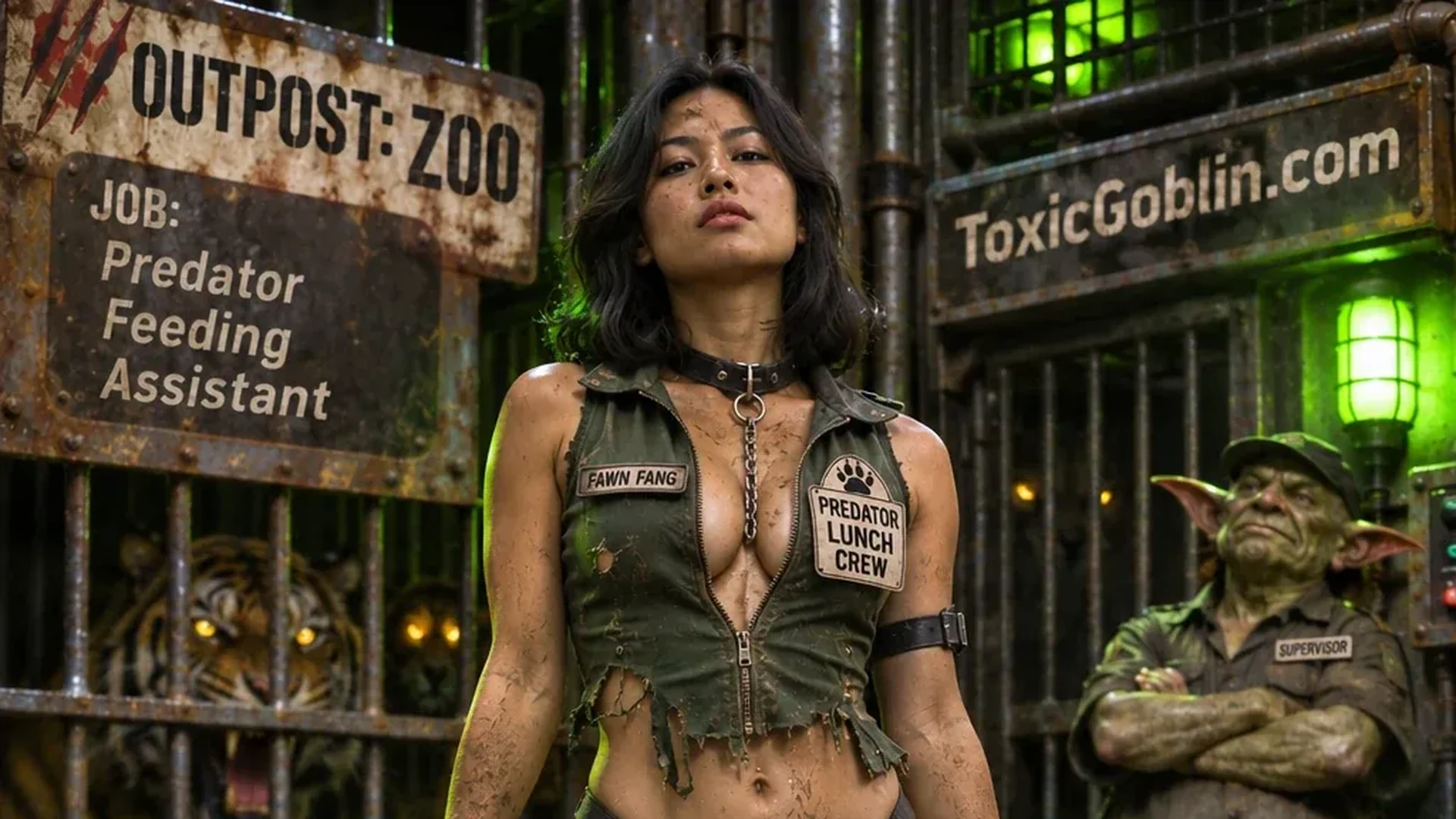
Fawn Fang and the Meal That Answered Back
A Predator Feeding Assistant turns a feeding demonstration into an argument with hungry echoes after claiming she can speak for every creature.
Read the origin ↓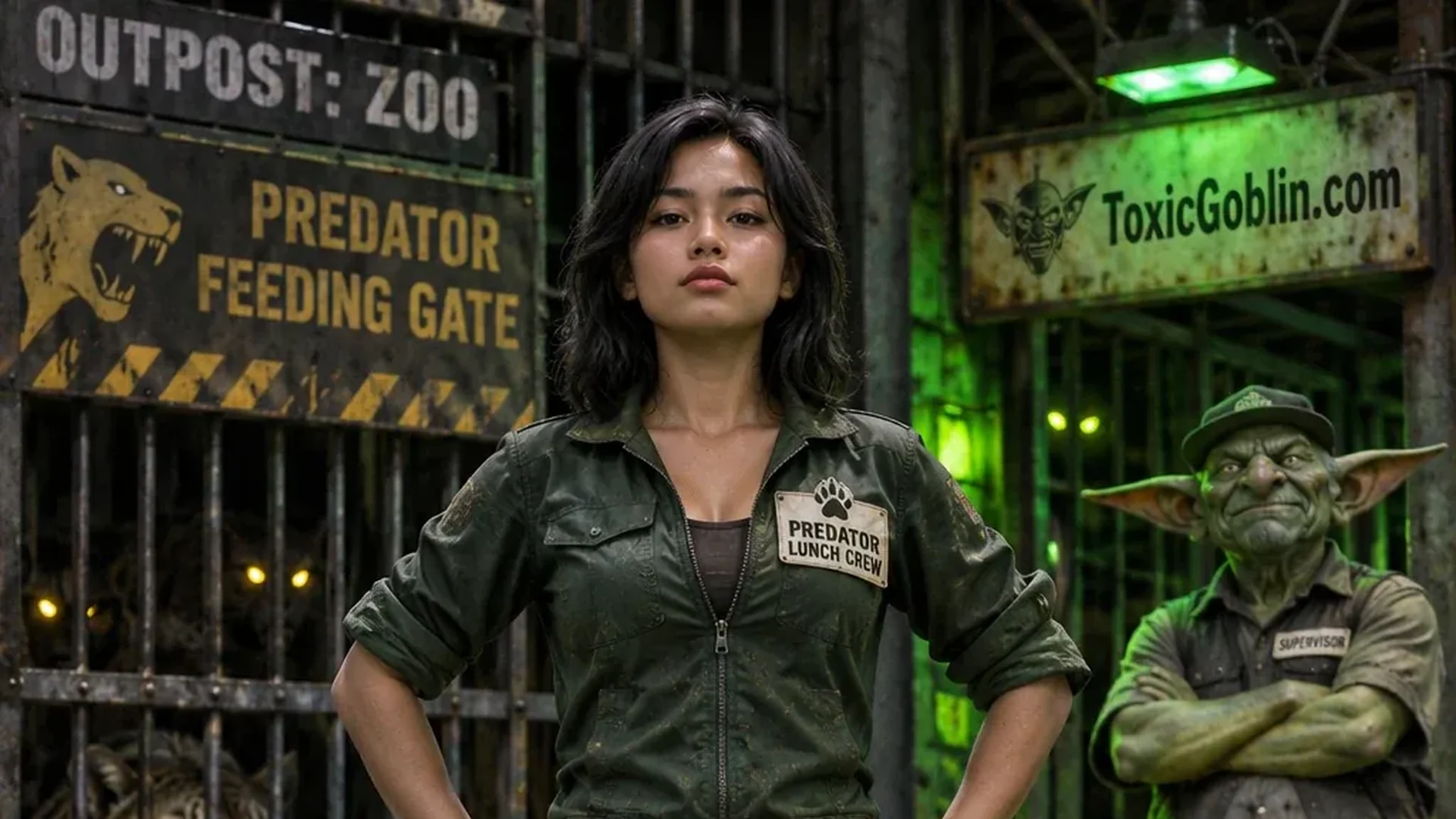
Fawn Fang could imitate every feeding call in the Zoo except the one that meant stop showing off. Nobody had taught her that call. Several colleagues claimed to have tried.
Fawn’s talent for imitation becomes a liability when something hungry learns to imitate her authority.
When the Goblin Council requested a demonstration, she offered them an entire conversation.
I said I understood it. I didn't say it agreed.
From the dossier
Prologue — An Excellent Impression
Her official title was Predator Feeding Assistant, a distinction the Goblin Council remembered whenever a meal went badly and forgot whenever a guest enjoyed the performance. Fawn knew their usual questions. They knew her usual answer: yes, she could manage that.
The Zoo's echo cats were not ordinary animals. They hunted sounds left behind after their makers departed. At closing, a loose laugh could skitter through the enclosure like a silver beetle. The cats gathered these scraps beneath their paws and ate them with expressions of profound concentration.
Their solid meals arrived on Fawn's cart. Their less solid meals arrived from visitors who had ignored the instruction to keep their remarks brief. The notice was widely mistaken for a joke, an error that supplied a reliable second course.
Fawn liked the cats. She liked, rather less admirably, being the person visitors watched instead of watching them. She had learned to shape her voice into their descending feeding trill. The cats answered. The crowd admired her. That was enough resemblance to understanding for her purposes.
A Council member with a collar of tin medals invited her to present this talent at the dusk inspection. He remembered a previous demonstration in which she had made his ceremonial horn sound embarrassingly small.
“Nothing improvised,” he said.
“Then don't ask questions.”
He laughed, assuming she had been charming.
In the preparation room, Fawn found an unfamiliar call scratched onto a wax cylinder. The label read RETURN OF THE FIRST HUNTER. Its diagram curled back on itself. She tried the opening note under her breath.
Every shadow in the room leaned toward her.
Fawn looked at the ordinary food cart, then at the cylinder. She imagined the Council standing to applaud. She put the cylinder in her pocket.
Act 1
Dinner for an Empty Cage
Act I — Dinner for an Empty Cage
The demonstration began well. Fawn rolled her cart into the service gallery, greeted the Council by title and offered a clipped feeding trill. Behind the divided glass, three echo cats emerged from their dark sleeping shelves.
Their coats held the colour of old smoke. Their paws made no sound. One carried a visitor's abandoned sneeze in its mouth and set it down delicately before approaching the meal slot.
The Council member with the medals asked whether they recognized individual voices. Fawn said of course. He asked whether she could summon their leader. The correct answer would have disappointed him for perhaps three seconds.
She gave him the opening note from the cylinder.
The cats stopped. In the empty fourth compartment, something breathed. Fawn continued, mistaking stillness for attention. Her borrowed call completed its curl, and her own shadow detached itself from her boots.
It crossed the floor toward the empty cage.
The audience applauded. Their applause broke into little dark shapes that ran after it. The fourth compartment filled with a silhouette too large for its dimensions. It had the outline of a cat until it turned; then it had the outline of something remembering a cat incorrectly.
Fawn repeated the ordinary feeding trill. All three real cats backed away.
“Wonderful,” said the councillor. “Does it take requests?”
The silhouette opened its mouth. In Fawn's exact voice, it said, “Of course.”
The service lights dimmed one by one. The feeding cart's shadow climbed onto the cart and flattened the trays beneath a weight that should not have existed. Nobody applauded again.
Fawn tried to laugh. The creature swallowed the sound before it reached the glass.
Across the gallery, her missing shadow raised its hand. Fawn kept both of hers on the cart. She finally understood that whatever she had invited was not waiting for food. It was waiting for her to finish telling it what it was allowed to do.
Act 2
A Voice Too Many
Act II — A Voice Too Many
The Council ordered the gallery closed, then objected to being included among the people inside it. Fawn ignored their discussion and watched the cats. The smallest had tucked its face beneath a shelf. The others faced the fourth compartment with their ears flat.
She tried a command she used when moving the cart. The silhouette repeated it. A service door slid open. She tried the sound that usually brought the cats forward. Every shadow in the gallery advanced instead.
The more authority she put into her voice, the larger the thing became.
A keeper at the far end made a small gesture: palm down, then still. Fawn nearly snapped that she had seen it. She stopped herself. The silhouette waited, mouth open, ready to acquire another piece of her.
The keeper moved a chalkboard along the wall. On it she wrote: YOU CALLED A HUNGER, NOT A CAT.
Fawn read the words twice. Her pride searched for a technical distinction that would make this somebody else's fault. The flattened trays offered none.
The hunger knew her commands because she had given it their shape. It could copy the councillor's cough and the squeak of a visitor's shoe. But when the smallest cat made a thin, irregular chirrup beneath the shelf, it did not answer.
Fawn had never copied that sound. She had considered it unimpressive.
She crouched by the glass and waited. The cat chirruped again, unevenly, with a gap where she expected a note. She tried to reproduce it perfectly. The hunger turned toward her.
Wrong.
Fawn swallowed the next attempt. The keeper watched without rescuing her. Beyond the glass, the cat nudged the uneaten sneeze toward its companions. They leaned close, making quiet sounds that overlapped without becoming a command.
For the first time that evening, Fawn asked a question she did not intend to answer herself.
“May I listen?” she whispered.
The hunger repeated the words. Nothing opened. Nothing moved. A question had given it nowhere to go.
Act 3
The Unfinished Call
Act III — The Unfinished Call
Fawn spoke softly to the empty compartment. She asked what it had come to eat. It repeated the question. She asked whether it knew the difference between a meal and an invitation. Again, it could only return her words.
The shape began to thin. Her shadow struggled inside its outline, still holding the posture she had used to accept the first applause. Fawn felt a sharp, ridiculous dislike for it.
Behind her, the councillor inhaled. She held up a finger without turning around. He managed, with visible effort, not to become an additional problem.

The smallest cat emerged from beneath the shelf. It chirruped, leaving its odd little gap. This time Fawn left the gap alone. The other cats filled it, not with an answer she recognized but with something they seemed to find satisfactory.
The hunger folded inward.
Fawn could have tried one magnificent final command. She felt the temptation like an itch between her shoulders. Instead she sat on the floor beside her crushed cart and let the cats continue a conversation that did not require her performance.
Her shadow slid back toward her. It hesitated at her heel, then attached itself.
The fourth compartment emptied. Somewhere inside it, the swallowed laugh escaped as a single small hiccup.
The Council demanded an explanation. Fawn told them she had used an unfamiliar call because she wanted to impress them. The councillor offered to describe the incident as a controlled display if she would perform it again for a larger delegation.
“No,” she said. It was the clearest sound she had made all evening.
Her demonstration allowance vanished. She spent the next shift replacing trays while the keeper handled the calls. Being useful without being watched proved less flattering than she had hoped, but the cats came forward to eat.
At closing, Fawn found the wax cylinder empty. Its scratched label had changed. In her own handwriting it now read REQUEST PENDING.
From the fourth compartment came a careful voice, almost hers.
“May I listen?”
Fawn did not answer. She carried her chair to the keeper's desk and placed the cylinder between them.
Feeding time in the echo-cat gallery
The Zoo’s fictional echo cats turn sound into part of their meals. Fawn’s demonstration tests the gap between recognizing a response and understanding a creature, with the Council’s appetite for spectacle making that gap more dangerous.