

Xenoverse origins / R-076
Hazel HazeOrigin story
Hazel Haze and the Barrel of Certain Disaster
A Toxic Waste Barrel Inspector becomes dependent on an enchanted forecast until avoiding every predicted mistake begins costing her the life she meant to protect.
Read the origin ↓
The barrel knew Hazel Haze would spill her tea. It said so three seconds before she did. By the time she found a cloth, it had predicted a broken appointment, a lost promotion and a mistake she would regret for the rest of her working life. Hazel asked which mistake. The barrel charged extra for details.
Hazel finds a forecast that is always persuasive and never explains what its advice leaves out.
A warning that cannot be questioned is another kind of order.
From the dossier
Prologue — A Prediction in the Receiving Bay
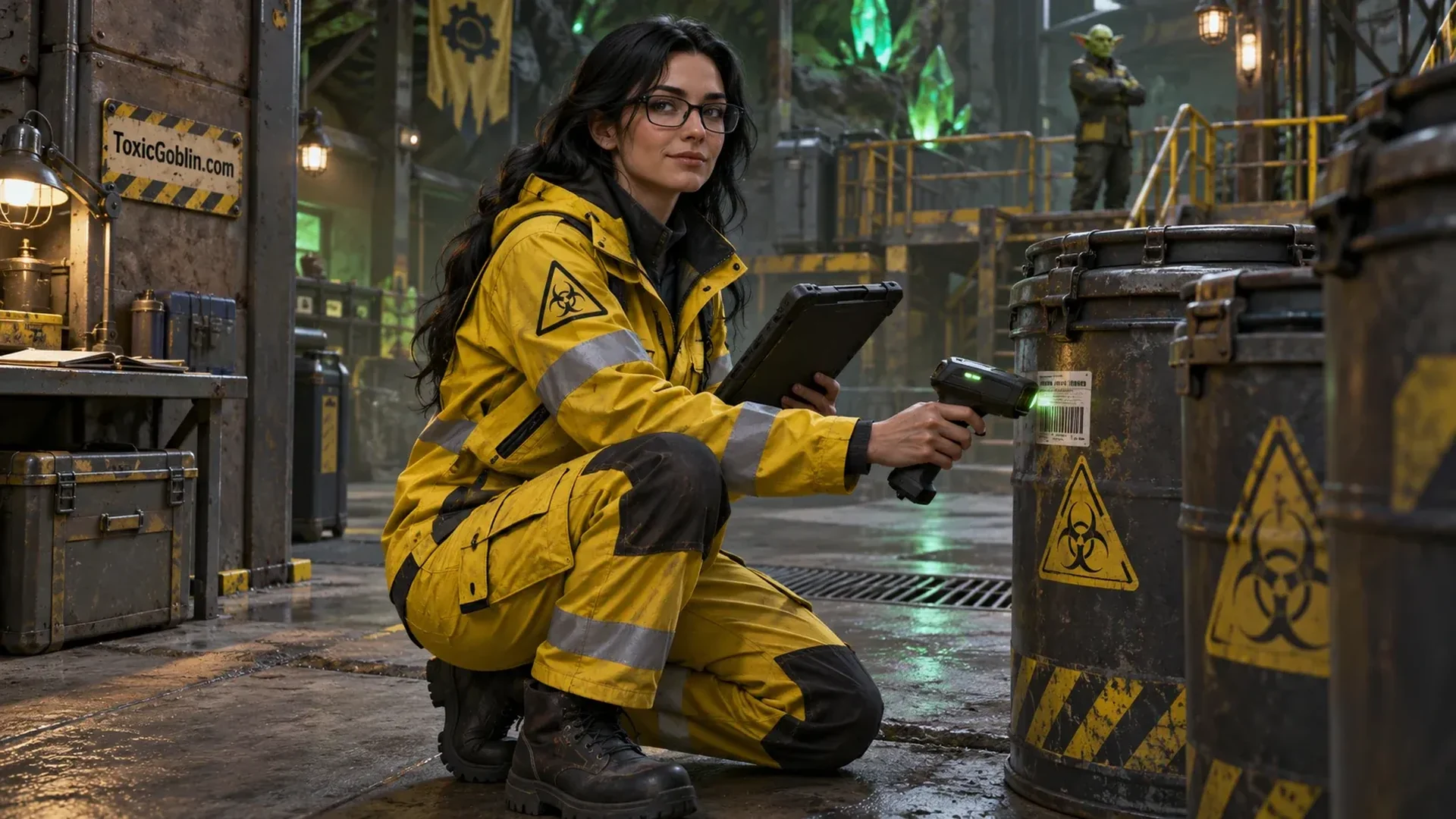
Industrial received its stranger consignments after sunset, when the ordinary clerks could plausibly claim not to have seen them. Hazel worked the late inspection desk beneath lamps that made every stain look significant. Her badge read Toxic Waste Barrel Inspector. Her preferred word was verify.
She knew the Goblin Council from hearings where uncertainty was treated as a personal defect. The Council knew her as the inspector with black glasses, exact questions and an unfortunate reluctance to agree that a confident answer was necessarily a correct one.
What Hazel disliked most was being wrong after warning someone else to be careful. She could endure ordinary embarrassment. She could not stop revisiting an incorrect judgment, turning it over in her mind until the original decision acquired an imaginary perfect alternative.
The new barrel arrived wrapped in a purple transport shroud. It carried no familiar hazard emblem. A little porcelain mouth protruded from its lid, surrounded by the words CONSEQUENCES AVAILABLE IN ADVANCE. Hazel placed it in the receiving gallery reserved for enchanted curiosities and sent for the duty assessor.
Before he arrived, it predicted the tea. Then it offered a free demonstration: do not take the west staircase tonight. Hazel used the east staircase instead. Through a window she watched a delivery imp on the western landing spill an entire tin of blue marking powder.
She reached home with clean boots and an uncomfortable sense of relief. Avoiding the spill proved nothing about the barrel's other claims. She knew that. Nevertheless, before leaving the next morning, she selected a question she had not yet decided to ask.
Act 1
The Comfort of Bad News
Act I — The Comfort of Bad News
The porcelain mouth required payment in small recollections. Nothing important, it promised: a tune, a pleasant smell, the colour of a room rarely visited. Hazel surrendered the memory of an annoying song. In return, it warned her not to submit an application for senior inspector.
She submitted it anyway, determined to test the prediction. A clerical error returned the envelope unopened. The barrel said this confirmed its advice. Hazel objected that an unopened application was not a failed one. The mouth replied that unnecessary disappointment was also a cost.
Her next question concerned a dinner invitation. The barrel predicted an argument. She declined and spent the evening quietly at home, unable to remember the song she normally hummed while washing dishes. It was a small absence, exactly the sort of absence she had agreed to purchase.
Councillor Pell visited the receiving gallery. He knew Hazel's questions well enough to notice when she stopped asking them. She explained the device. Pell proposed using it to eliminate troublesome possibilities from every Council decision. Hazel said they did not yet know whether its predictions were useful.
Despite her objection, she kept consulting it. It warned her against a difficult conversation with a friend, a new walking route and a request for time away. Each avoided event left her feeling momentarily sensible. Each quiet evening became harder to distinguish from the one before.
Then the friend came to the gallery herself. She asked why Hazel no longer answered invitations. Hazel began to explain, but the friend's familiar perfume meant nothing to her. She had paid that memory for a prediction about an argument they were now having anyway.
Act 2
What the Forecast Leaves Out
Act II — What the Forecast Leaves Out
Hazel asked the barrel to predict something good. It explained that good outcomes did not require warnings. She asked whether its bad outcomes were inevitable. It explained that inevitability was an expensive category. She recognized the rhythm: each useful question moved the answer behind another charge.
She reviewed her own notes. The barrel had predicted embarrassment, inconvenience and disagreement with wonderful accuracy. It had never predicted reconciliation, delight or the relief of changing her mind. Her list described a world in which nothing unpleasant led anywhere worth going.
Pell announced that the Council would acquire the device. To demonstrate its value, Hazel would ask about an upcoming decision and follow its advice publicly. She refused. He reminded her of the application he could arrange to have properly delivered. The offer was effective because it was ordinary.
That night, the barrel spoke without being asked. A shipment would arrive carrying a mistake with her signature on it. If she let it cross the gallery, somebody would lose everything. If she refused it, her career would end. It offered a complete forecast in exchange for the memory of her friend.
Hazel sat opposite the porcelain mouth until dawn. She could not prove the warning false. That was its grip on her: a possibility described with enough confidence began to feel like a responsibility. She wanted certainty badly enough to feel the price becoming reasonable.
Instead she called her friend and asked her to come. She admitted what she had forgotten and why. The conversation was painful, untidy and entirely absent from the forecast. When the first delivery bells rang outside, Hazel was still listening to an answer she had not paid to predict.
Act 3
A Signature Without a Guarantee
Act III — A Signature Without a Guarantee
The shipment contained an ordinary sealed collection of enchanted refuse, with Hazel's authorization attached. She reviewed the information available, brought the duty assessor into the decision and recorded what remained unknown. The barrel shouted increasingly specific disasters. She left it unanswered in its separate gallery.
Pell demanded a yes or no that would excuse everyone else from thinking. Hazel gave him a decision with conditions he disliked because they required further work. He accused her of losing confidence. She said she had lost confidence in the barrel, which was more precise.
The shipment went where the assessors had agreed it belonged. Nothing dramatic happened before closing. Hazel did not claim victory. A quiet afternoon could not settle every future consequence, and she was no longer willing to let one impressive moment stand in for an explanation.

Pell acquired the barrel anyway. The Council preferred a device that supplied warnings to an inspector who supplied questions. Hazel's promotion application disappeared into another administrative corridor. She watched the purple shroud leave on its trolley, feeling neither vindicated nor entirely safe.
Her friend invited her to dinner again. They argued about something small, apologized badly and enjoyed the rest of the meal. Hazel could not recover the lost perfume memory by wishing. She began learning it afresh, an imperfect repair that cost attention instead of another piece of herself.
At work, a sealed invitation waited on her desk. The Council required her presence at a private hearing; the barrel had predicted a disaster involving an inspector who refused its advice. Beneath the formal summons, Pell had added a hurried note in pencil: Please come before I forget why I trusted you.
The limit of a perfect prediction
At Industrial, the Toxic Waste Barrel Inspector must make judgments from incomplete evidence. Hazel's supernatural forecasting device embodies the temptation to replace those judgments with certainty; its workings are fictional and offer no real hazardous-material guidance.