

Xenoverse origins / R-060
Riley RattleOrigin story
Riley Rattle: The Missing Minute
An impatient test rider discovers that an enchanted coaster has been storing the uneventful moments she demanded it skip.
Read the origin ↓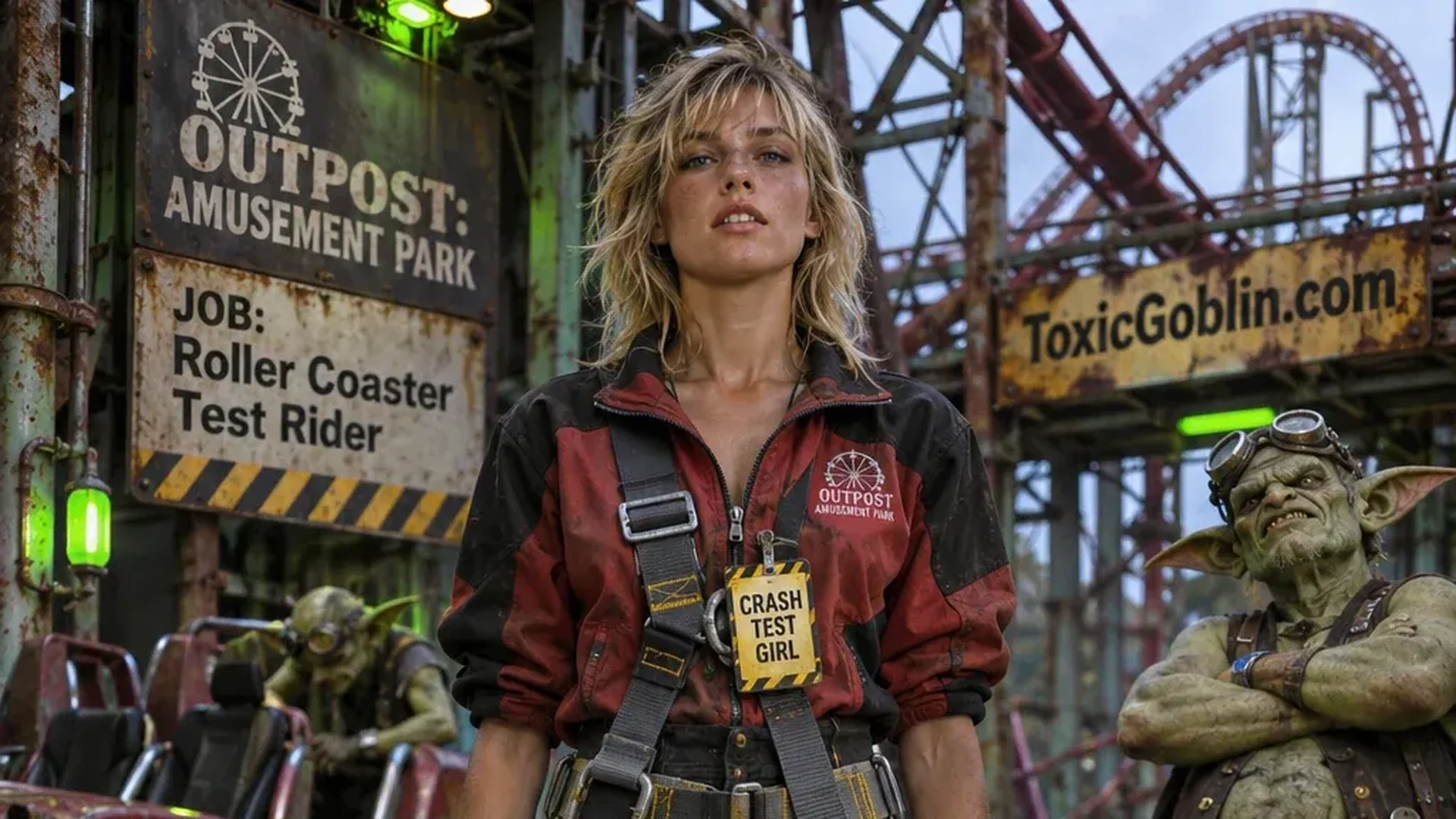
Riley Rattle hated the climb before the drop. Too much clicking, too much sky, too much time to wonder whether she had left her locker open. Her test reports repeatedly described it as dead space.
The coaster returns ahead of schedule, but a second Riley is still waiting inside the minute it discarded.
The new coaster took her criticism literally. It delivered the drop without the climb. When Riley returned to the station, her locker was open, her lunch was gone, and someone in her handwriting had left a note: DON'T SAVE TIME ON ME.
I want the whole ride, including the bits I complained about.
From the dossier
Prologue — Faster than Her Signature
The note annoyed Riley more than the missing lunch. Anyone who borrowed her handwriting ought to have borrowed better punctuation. She crumpled it and asked the dispatcher when he had seen her leave the station.
He said she had never left.
Riley was the Amusement Park outpost's Roller Coaster Test Rider. The Goblin Council valued her blunt opinions, particularly when they could be printed beside an admission price. She knew its attraction committee well enough to recognise a cost-cutting exercise disguised as a breakthrough.
The new car carried a polished plaque: CONTINUOUS EXCITEMENT. Its enchantment removed moments that did not contribute to the experience. Riley had enthusiastically endorsed that phrase during the briefing. Now she wondered who had defined contribute.
The dispatcher showed her the trip clock. The ride had taken a minute less than the test schedule. Her written report, already waiting on his desk, praised the improvement. She had not written it yet.
“Efficient,” he said.
“Presumptuous.”
He offered her a replacement lunch voucher. It was dated for the previous shift and had already been redeemed.
Riley straightened the crumpled note. Beneath the main message, someone had added a smaller line: YOU ALWAYS THINK WAITING BELONGS TO SOMEBODY ELSE.
That sounded uncomfortably like her own better arguments. She put the note in her jacket rather than handing it to management.
The second test would be private. If there was a trick, she wanted to discover it before the Council discovered her involvement.
Act 1
A Station between Stations
Act I — A Station between Stations
This time Riley watched the clock until the hands blurred. The track clicked beneath the car, a cloud moved across the sun, and then she was standing in a station made entirely of the intervals between those things.
Its benches held unfinished gestures. A goblin reaching for a handkerchief. A worker about to remember a name. Riley herself, halfway through opening a lunch tin. None seemed frozen exactly. They moved with the slow resentment of people whose appointments had been cancelled without their consent.
At the far end, another Riley sat on a crate eating a sandwich.
“You took your time,” said the other Riley.
“I was trying not to.”
“Yes. We noticed.”
The double had been assembled from all the uneventful parts the coaster had removed. She remembered the climb, the ordinary view beyond the rails, the moment Riley had nearly admitted she was nervous. She had also remembered being hungry.
Riley demanded that the ride put everything back. Her double pointed to a departure board. Every line read NOTHING OF INTEREST.
The enchantment was obeying her own assessment. She had signed a report declaring those moments unnecessary before she understood that they contained portions of an actual person.
A whistle sounded. The arriving car had only one occupied seat: Riley's body, looking impatient to be rejoined.
She grabbed for her double's sleeve. Her hand passed through a memory of reaching. Then she was back at the ordinary station, clutching half a sandwich she did not recall taking.
The dispatcher admired the improved duration. Another minute had disappeared.
Riley asked him to close the ride. He said that required a fault description.
She considered every possible explanation, then wrote the simplest one.
“The passenger has not entirely returned.”
He read it twice and quietly turned the admission board around.
Act 2
The Committee Requests a Shortcut
Act II — The Committee Requests a Shortcut
The Council committee met her at the locked entrance. Its chair already knew about the missing time. Unfortunately, he considered it a benefit rather than a fault. People spent too much of their lives waiting; the attraction was generously reducing the burden.
Riley placed the half-sandwich on his inspection tray.
“That's where the other half of me had lunch.”

The committee asked whether this additional passenger required a ticket.
Riley could have laughed. Normally she would have supplied a sharper joke and let the meeting become someone else's problem. Instead, she described the unfinished people in the hidden station. Some belonged to tests performed before hers. The enchantment had been collecting quiet moments since installation.
The committee offered to rename them optional experiences. Riley refused to sign.
Her earlier endorsement gave them leverage. They could publish it, suspend her test privileges and replace her with a weighted sack. The chair observed that sacks seldom developed philosophical objections after approving a procurement.
Riley agreed that her original report had been foolish. Hearing herself say it brought an unpleasant relief. The Council could still punish her, but it could no longer threaten to reveal something she was actively concealing.
“I want the whole ride, including the bits I complained about,” Riley said. She proposed one complete test. No demand for speed. No promise of excitement. She would record the intervals she had previously discarded and determine whether they could be restored.
The chair allowed it because a recoverable passenger sounded less expensive than an unresolved one.
Before boarding, Riley emptied her pockets. She left the clock, the report cards and the little bell she used to mark dull sections. The dispatcher asked how she would judge the ride without them.
“Badly at first.”
He gave her a blank notebook anyway. This time she wrote on its cover before the car moved: THINGS THAT HAPPEN WHILE NOTHING HAPPENS.
Act 3
The Long Way Back
Act III — The Long Way Back
The climb lasted longer than Riley remembered. Every click sounded like another opportunity to complain. She began noticing smaller things to avoid counting them: a paint streak on the rail, a crooked weather vane, the smell of rain trapped in the wooden supports.
The hidden station appeared between two clicks.
Her double was waiting with the empty lunch tin. Riley apologised for treating her as waste. The double said an apology was a promising start but a poor form of transportation.

They walked the benches together. Riley listened to the goblin finish the sentence interrupted by his handkerchief. She waited while the worker remembered the name. She sat beside the almost-nervous version of herself without offering reassurance designed to hurry the feeling away.
Each completed moment loosened a section of the station. The benches grew transparent. Beyond them, the ordinary climb returned in patches of sky.
The double held the lunch tin out.
“You'll be bored.”
“Almost certainly.”
“And you'll complain.”
“Probably. I don't have to be right about it.”
They sat together in the arriving car. There was room now, although Riley could not have explained which of them occupied it. The track climbed, clicked and climbed again. When the drop finally came, she experienced it with all the inconvenient minutes that had made it possible.
Back at the entrance, the Council withdrew its continuous-excitement claim. Riley's endorsement fee was deducted from her next payment. She kept the notebook and submitted a report several pages longer than anyone had requested.
The dispatcher counted the returned passengers. One unfinished moment remained.
It arrived after closing: a clean car with nobody aboard and a lunch tin on the seat. Inside the tin lay a note in Riley's handwriting, weathered and soft from repeated folding.
THANK YOU FOR LEAVING ROOM.
The departure board displayed a destination the ride had never possessed.
Riley locked the gate and stayed beside it, resisting the urge to find out quickly.
The cost of cutting the quiet parts
Riley's work at the Amusement Park turns sensations into judgments the Council can sell. A ride that edits its own duration exposes the weakness in her favourite criticism: she treats every uneventful interval as something nobody could possibly need.