

Xenoverse origins / R-080
Blair BlizzardOrigin story
Blair Blizzard and the Bell That Rang Tomorrow
An exacting warning technician hears a bell from the future and must act without knowing whether her response will prevent the event or cause it.
Read the origin ↓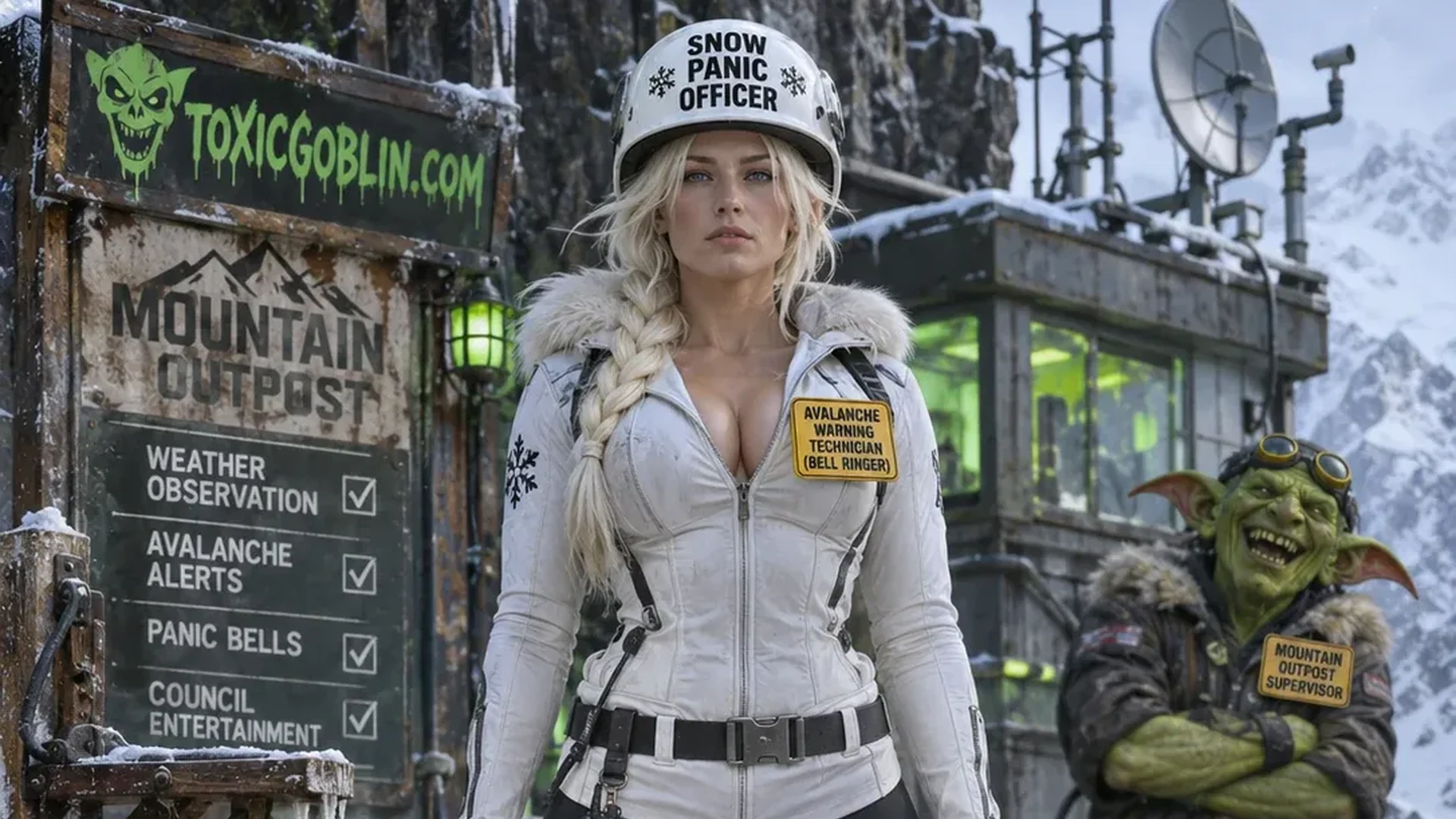
At the Mountain outpost, a bell before breakfast meant trouble. A bell before its own clapper moved meant Blair Blizzard would be missing breakfast entirely. She stood beneath the silent bronze mouth, her notebook open, while the sound rolled back across the ridge for a second time.
Blair Blizzard must make a decision before a mysterious warning reveals what it is warning her about.
I can tell you what I heard. I cannot sell you what happens next.
From the dossier
Prologue — Seven Seconds of Authority
Blair's official post was Avalanche Warning Technician. The Goblin Council had once asked her to shorten it for a badge, then rejected every abbreviation because it sounded insufficiently reassuring. She kept the full title pinned to her white jacket and took private satisfaction in having the only accurately spelled sign on the tower.
Her reputation rested on timing. Blair could identify which valley had answered a bell and measure the delay between a distant crack and its echo. She liked figures because they did not ask her to sound more confident at receptions.
Councillor Dreg knew her well enough to send corrections to her corrections. She knew him well enough to keep the originals. Their relationship was cordial whenever the mountain cooperated.
On the morning of the inspection, the tower bell sounded seven seconds before the clapper moved. Blair saw the iron hanging still while the note trembled in her teeth. Then the clapper swung and struck, producing no sound at all.
She recorded both events.
Her tower keeper, Voss, suggested a ghost. Blair rejected the suggestion because the ghost register had no appointment listed. Voss said this seemed an ambitious expectation of the dead.
The next sound came from a handbell locked in a drawer. Three quick strokes, followed by Blair's own voice saying, very clearly, "Leave the chair."
She had never said it.
Act 1
The Forecast Requests a Witness
Act I — The Forecast Requests a Witness
Dreg arrived with a ceremonial chair and a speech about the Council's successful ownership of winter. The chair was to be placed on the observation balcony. From it, he would declare the tower's new echo crystal operational. A white feather worked free of the cushion and drifted against the wind into Blair's hand. Dreg brushed it away before she could examine it.
Blair had not installed an echo crystal.
Voss pointed to the ceiling. Overnight contractors had fitted a clear stone above the bell frame. Its purpose, according to the plaque, was to reduce warning delays by removing unnecessary waiting. The stone leaned toward sounds that had not occurred yet.
Blair demanded the contractor's instructions. Dreg handed her a ribbon-cutting schedule.
The crystal sounded the drawer bell again. This time the borrowed voice said, "Leave the chair," followed by splintering wood and a tremendous white roar. Outside, snow moved across the ridge in long, uncertain veils.
Dreg asked whether an avalanche was certain.
Blair checked the crystal's angles, the balcony supports, and her instruments. Every familiar reading disagreed with the sound. She could offer possibilities. She could not provide the clean statement the Council expected.
"Then we proceed," Dreg said. "A possibility is just a complaint without evidence."
Blair hated that she had trained him to think this way. Whenever a forecast had been uncertain, she had worked longer, calculated harder, and presented the narrowest conclusion she could defend. He had begun treating doubt as an unfinished service.
Voss lifted the ceremonial chair. Blair snapped at him to leave it, then stopped with her mouth open.
The crystal gave a satisfied little chime.
There was the sentence. She had spoken the sentence.
Dreg smiled as though the equipment had just demonstrated excellent customer support.
Act 2
A Sound without a Cause
Act II — A Sound without a Cause
Blair sent the inspection party inside the stone chamber and closed the balcony door. Dreg protested that an indoor inspection of a view lacked conviction. Voss quietly moved the tea tray out of throwing distance.
Through the glass, the crystal showed a pale reflection of the balcony. Blair saw a chair overturning and a white shape rushing past. Each time she leaned closer, the scene shifted. In one version Voss stood there. In another she did. Dreg appeared in all of them, looking offended.
She could not tell whether the crystal predicted a future or rehearsed one assembled from their fears. Its magic had arrived without instructions because the Council had purchased the demonstration model.

Blair considered striking the main bell. That would summon every neighboring post and possibly make the unheard disaster real through a different chain of events. She considered doing nothing. That offered the attractive illusion of innocence.
Voss sat on a crate. "What would you tell someone else to do?"
"Not install an untested crystal."
"Someone else who already had."
Blair opened her notebook to the page she disliked most: observations insufficient. She wrote down what was known. The balcony was empty. The crystal repeated future sounds. The source of the white roar remained unknown. The mountain had not promised to explain itself before they moved.
She took the tower's plain service bell, the one used to call a replacement shift. Its dull note had no grandeur and no code for catastrophe.
Then she addressed the inspection party.
"I can tell you what I heard. I cannot sell you what happens next."
Dreg demanded a recommendation.
Blair gave one: end the demonstration, surrender the balcony, and wait in the inner room. She signed her own name beneath it. No prediction disguised as an order. No claim that the uncertainty belonged to somebody else.
Act 3
The Empty Seat
Act III — The Empty Seat
They waited through the hour appointed for the ceremony. Dreg complained quietly at first, then with growing invention. Blair listened to every change in the wind and resisted the urge to turn each one into an answer.
At noon, the crystal called out in her voice once more. "Leave the chair."
The balcony door burst inward.

White feathers filled the room.
The ceremonial chair had been upholstered with the down of a cloud goose, an aggressively territorial creature whose feathers occasionally remembered the bird. The echo crystal had offered them a future in which they were still attached. They had accepted.
The chair tore apart in a furious white spiral. The crystal cracked as the impossible goose tried to occupy the balcony, the bell tower, and yesterday simultaneously. Splinters rattled against the closed inner door. Nobody was seated where the chair had been.
Voss stared at a feather that had forced itself through the keyhole. "Not an avalanche."
"Not this time," Blair said.
She felt relief, then embarrassment at the size of it. Her dreadful warning had concerned furniture. The people behind her were alive, irritated, and certain to tell the story in the least flattering order.
Dreg called it an avoidable delay. Blair agreed that much could have been avoided. She returned the demonstration plaque and kept her signed recommendation.
The Council removed the crystal. It retained the inspection fee and instructed Blair to prepare a briefing on distinctions between geological and upholstery emergencies. Voss offered to illustrate it. She accepted before pride could interfere.
That evening, Blair revised the tower's reports. Alongside clear observations and estimates, she added a space for what they did not know. It made the pages untidy. It made them more useful.
As she locked the drawer, the little handbell sounded once.
No voice followed. No clapper moved.
Blair opened her notebook again. Instead of inventing a cause, she wrote the time and woke Voss. Whatever the sound meant, this observation would have two witnesses.
What the warning tower cannot promise
Blair's Mountain outpost depends on observations, judgment, and people willing to listen. The Council's new crystal introduces an impossible complication: hearing an event early does not establish its cause.