

Xenoverse origins / R-081
Penny PeaksOrigin story
Penny Peaks and the Toll on the Last Word
A competitive toll collector sells passage in exchange for the last word and discovers that winning every exchange leaves her unable to finish anything.
Read the origin ↓
Penny Peaks had collected copper, silver, two acceptable buttons, and a goat of disputed ownership before the traveler offered her the last word. She nearly waved him through on principle. Then she imagined the look on the Council assessor's face when she presented a revenue stream nobody else had thought to tax.
Penny Peaks acquires the power to win every dispute, at the cost of letting anything reach an ending.
Keep the coin. I am trying to lose this argument.
From the dossier
Prologue — A Profitable Conversation
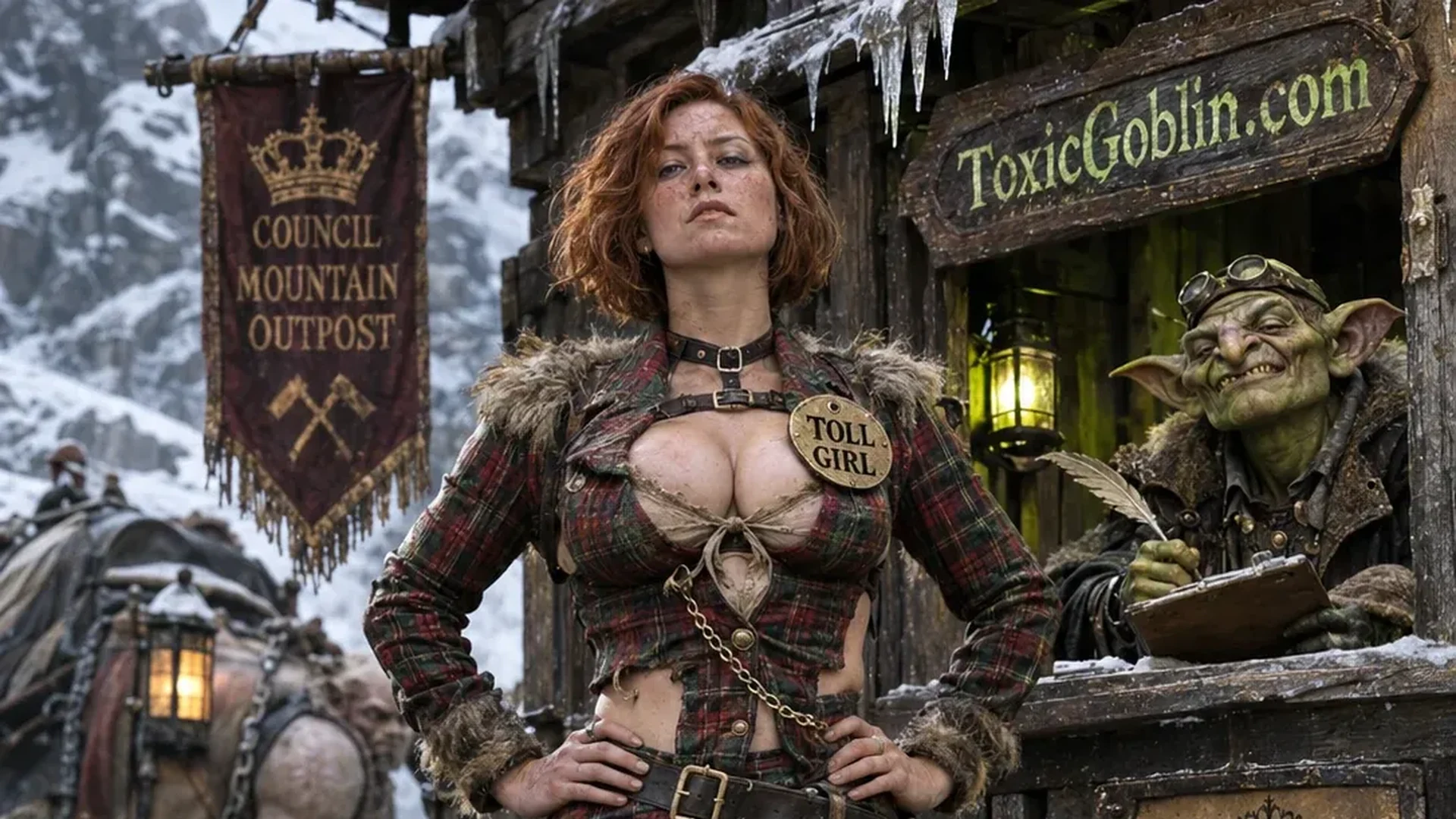
The Mountain Toll Collector worked from the Mountain outpost's booth, barely wide enough for a chair and a bad mood. Penny kept hers tidy. Her tartan coat hung beside a shelf of confiscated excuses, each curled inside a labeled jar.
A framed reversal from the Goblin Council hung above her till. Penny had once charged a visiting delegation for its accompanying sense of importance. The councillors reversed the charge, remembered her name, and thereafter summoned her personally whenever receipts disappointed them. She could identify each official by the excuse their servants brought.
She enjoyed an argument more than a meal and sometimes forgot the meal altogether. Nothing irritated her like a traveler who accepted the price without giving her an opportunity to defend it.
The stranger wore a coat stitched from old road signs. He carried a small brass box and insisted that the last word was legal tender on roads that remembered a king. Penny's road remembered several, none fondly.
"How much is it worth?" she asked.
"As much as you insist."
That sounded like an excellent basis for negotiation. Penny accepted the box, stamped his passage slip, and watched him walk over the bridge.
He turned at the far end as if to add something.
Penny called, "And that's final."
The box clicked shut. For the rest of the morning, every traveler agreed with her before realizing they had done it.
Act 1
Nothing Left to Say
Act I — Nothing Left to Say
By midday, Penny had resolved nine disputes in her favor. A merchant admitted his wagon had four wheels rather than the two he preferred to declare. A goblin pilgrim agreed that floating over a bridge still counted as using the crossing. Even the weather seemed to hold off until she finished speaking.
She began charging a conversation fee.
The booth's bell chimed for every satisfied conclusion. Inside the brass box, small dark shapes gathered like punctuation. Penny tilted it toward the light. They pressed against the lid.
Councillor Pell arrived to inspect the returns. He complimented her initiative, which meant he wanted it without paying. Penny refused to surrender the box until the Council guaranteed a share of the income.
"Naturally," Pell said.
He looked horrified.
Penny smiled. It was the happiest professional moment she had experienced all season.
Then her lunch refused to end. She took the last bite of her pastry and discovered another last bite beneath it. The closing bell rang without completing its note. A traveler crossed the bridge, reached the far side, and stepped immediately back into the queue.
By dusk, the same five people had paid repeatedly. They were no longer argumentative. They were frightened.
Penny refunded the charges for the repeated crossings, but kept the original tolls, including the pilgrim's disputed coin. The bridge brought the travellers back anyway.
The stranger in the road-sign coat stood at the rear of the line, holding his passage slip. "You purchased the last word," he said. "There isn't another one available for endings."
Penny told him that was ridiculous.
The brass box clicked. He nodded against his will. The sun stopped just above the ridge, as if waiting for permission to set.
Act 2
A Queue of Unfinished Things
Act II — A Queue of Unfinished Things
Pell attempted to leave on official business. The bridge returned him with his hat turned backward. Penny laughed before remembering that she had caused it. The sound did not help.
She opened the box. Its dark contents rose into the booth and settled on every notice. Full stops vanished. Rules became sentences that could never finish. A confiscated excuse escaped its jar and began explaining a missing axle with no sign of reaching the relevant event.
The stranger said the transaction could be reversed only by an exchange she genuinely lost. Not a trick, not a staged surrender, and not a promise to lose later. He was a trader in conclusions, not an arbitrator of good intentions.
Penny offered to refund his toll twice over. He refused. She offered the booth. He asked whether she owned it. She offered Pell.
"Also not yours," the stranger said.
Pell objected to the order in which his eligibility had been considered.
Outside, the queue began organizing itself. The merchant shared water. The pilgrim helped move a tired traveler's bags. People who had spent the day being corrected found things to do that did not require being right.
Penny looked at the extra receipt she had issued to the floating pilgrim. She still believed the charge was valid. The pilgrim had used the bridge's shelter from the wind and enjoyed its view without maintaining any of it. Penny could construct a beautiful argument.
She went outside and asked what the pilgrim thought.
"I think you liked making me land."
That was unfair. It was also partly true.
Penny began explaining the bridge's costs. The box warmed beneath her arm. Another ending tightened inside it. She stopped halfway through the sentence.
"Keep the coin. I am trying to lose this argument."
"You haven't returned it yet," the pilgrim said.
Penny opened her purse.
Act 3
The Price of an Unfinished Reply
Act III — The Price of an Unfinished Reply
She handed over the coin without a receipt, qualification, or little speech. The pilgrim put it away.
"Thank you," he said. "Your rule was petty."
Penny's reply arrived fully formed. It included the cost of maintaining the western support, the legal definition of passage, and an excellent comparison involving umbrellas. She could feel the words crowding her teeth.

She let them stay there.
The brass box sprang open. A black dot flew into the evening sky. The sun dropped behind the ridge. Across the bridge, the waiting merchant reached the far bank and remained there, shouting so enthusiastically that his mule objected.
The bell finished its note. Penny's pastry became, at last, a collection of crumbs.
Pell demanded to know why she had surrendered legitimate revenue. Penny could have used the remaining magic to make him accept the expense. Instead, she told him she had made a bad purchase and would pay the shortfall herself.
He accepted this with the speed of a man watching someone volunteer for his least favorite part of an investigation. The Council would retain the phrase "conversation fee" for possible future use.
The stranger collected his empty box. He offered Penny a discount on a first impression, lightly used. She told him to take the ordinary road and pay in ordinary money next time.
At closing, she removed the new fee notice. She kept the old toll rates, the excuse jars, and most of her opinions. Improvement did not require becoming pleasant to people who pretended wagons had fewer wheels.
The pilgrim returned on foot just before dark. He had found something caught in his scarf: a small black comma, warm and restless. It moved whenever Penny looked away.
"Yours?" he asked.
She considered saying no. Instead she found an empty jar.
Behind them, the bridge gave a gentle creak. On its far side stood a queue of carts that had not been there a moment before. Their drivers wore the same road-sign cloth as the stranger.
Penny opened the shutter. This time she listened to the first request all the way through.
What counts as payment at the crossing
Penny's Mountain toll booth stands between travelers and the pass. Coin usually settles the transaction; an unfamiliar form of payment turns her fondness for argument into a problem for everyone waiting to cross.