

Xenoverse origins / R-056
Dusty SpursOrigin story
Dusty Spurs and the Last Stall on the Left
A Rodeo Stable Mucker preparing to depart must decide whether to spend her hard-won passage on a forgotten creature whose ghost cannot leave its stall.
Read the origin ↓
Dusty Spurs counted her passage money twice, then counted the stalls. The money was correct. The stalls were not.
An impossible stall puts Dusty's planned departure in conflict with a creature she thought had already gone.
There had always been an empty space at the end of the left-hand row. Tonight it had a door, a feeding trough and something heavy breathing behind the wood.
I can finish the shift. That doesn't mean the place is finished with me.
From the dossier
Prologue — The Price of the Far Bank
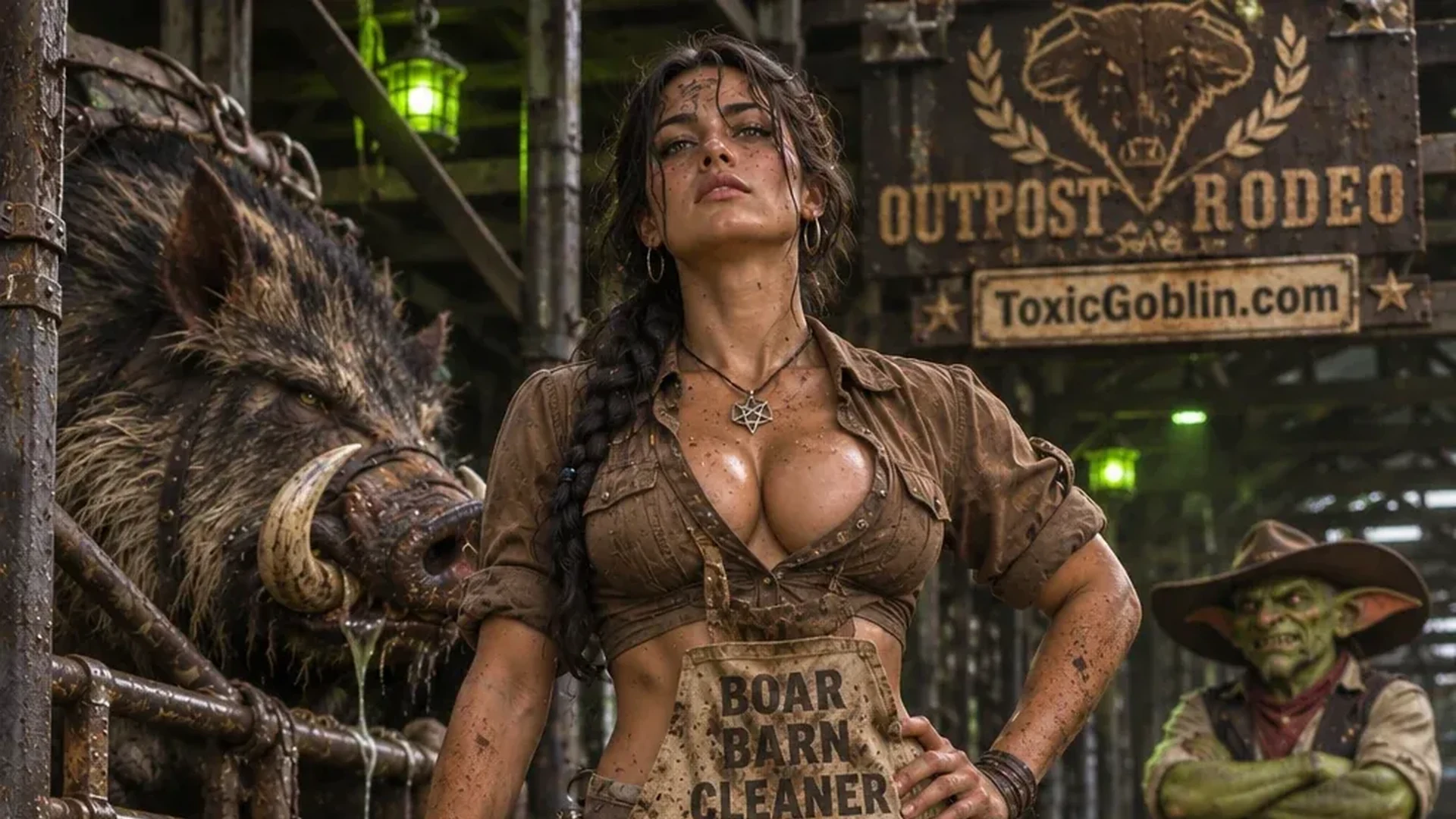
Dusty worked as Rodeo Stable Mucker. She cleared bedding, hauled loaded carts and learned more about the Rodeo's condition from its stable floors than its inspectors learned from their tours. Her brown work apron carried the weight of a job nobody noticed until it stopped being done.
The Goblin Council knew her. She had guided its members through the stables during an inspection and charged them a bucket each for the trouble of getting in her way. They had called this insolence, then paid because the visit was being recorded by their own clerk.
Dusty knew which councillor could pronounce every champion's name and none of the stable workers'. She did not expect that to change. She had decided to change something she could afford.
A river boat left at dawn for the far bank. She had bought a passage and arranged leave from her shift. Beyond the river stood an employment hall with a roof that reportedly did not leak. She possessed no promise of a better job, only enough money to discover whether one existed.
She had told nobody in the stables. Goodbyes invited requests, and requests had a way of turning one last favour into another season.
Then the extra stall appeared.
Its latch was cold. The trough inside held no feed. Fresh straw covered the floor, though she had cleared that space before supper. In the bedding lay the impression of a massive body. Two hoofprints pressed deep beside it.
Dusty stood outside with her fork.
“I'm not scheduled for additional accommodation,” she told the door.
A bell rang softly inside.
She knew the sound. It belonged to a small iron bell that had hung from a retired boar's harness. The animal was gone; its stall had been dismantled. Dusty herself had carried the boards away.
She set the fork against the wall and reached for a latch she very much wanted to leave untouched.
Act 1
Bedding for Nobody
Act I — Bedding for Nobody
The door opened onto an ordinary empty stall. Dusty could see the far wall through the place where a creature should have stood. Yet the straw compressed beneath invisible feet, and warm breath moved the loose end of her scarf.
She remembered the boar's working name: Cinder. The Council had preferred a ceremonial title too long to fit on its harness. Dusty had used the short name while cleaning around its stubborn refusal to stand anywhere convenient.
“Cinder?”
The bell answered.
She should have felt frightened. Instead she felt the exhausted annoyance of discovering a familiar problem after its paperwork had been closed.
The stable overseer refused to inspect the stall. He remembered Cinder perfectly well and considered remembering sufficient. The Council had commissioned a memorial. If the boar remained dissatisfied, he suggested, it should direct its complaint toward the sculptor.
Dusty went to the memorial herself. It showed an upright, ferocious beast beneath a victorious banner. Cinder had spent most quiet afternoons asleep against a warm wall. The statue looked nothing like the creature she had known.
A Council delegate found her there. He recognized the apron before her face.
“Spurs. Has somebody damaged the base?”
“No. You've made him look employed forever.”
The delegate studied the statue. He said that was an honour.
Dusty asked what had become of the harness bell. It had been placed in the memorial store, along with objects considered too plain for display. She asked to borrow it. The delegate refused until she offered the fee she had saved for food on the crossing.
He accepted with the air of a man encouraging civic participation.
Back at the stall, she hung the bell beside the trough. The unseen creature pressed against the door. Beyond its weight, she heard a sound impossible in the dry stable: water striking the side of a boat.
Cinder had not returned for another shift.
He was waiting for a way out.
Act 2
A Passenger Too Large to See
Act II — A Passenger Too Large to See
Dusty took the bell down. The weight followed it into the aisle. Straw lifted beneath invisible hooves. At the outer stable door, the sound stopped. Cinder would go no farther.
A carter waiting in the yard watched her hold a bell toward an apparently empty doorway. He did not laugh. The Rodeo supplied stranger sights without requiring spectators to leave their seats.
He asked whether the passage had been paid.
Dusty showed him her boat token. It bore a small arch and the words ONE CROSSING. The ferryman, he explained, accepted creatures remembered more strongly than the places that held them. But each passenger needed a passage of its own. A ghost did not count as luggage simply because it was difficult to see.
She asked how he knew.
“I carried a cart that kept its dead horse,” he said. “Long journey.”
Dusty considered buying another token. The boat office had closed. She considered giving Cinder hers and purchasing a replacement later. That word later held every postponed departure she had not spoken aloud.
Inside her room, her packed bag waited beneath the bed. She opened it and removed the spare work shirt. The practical part of her mind began calculating how quickly she could save the fare again. Another part refused to turn the decision into arithmetic before she admitted what it cost.
She wanted to leave. She still wanted to leave.
Cinder's bell sounded from the stable door. Dusty remembered how she had resented cleaning the patch where he preferred to sleep. She also remembered the steady warmth of his flank through the boards on cold shifts, and how the aisle had seemed larger after he was gone.
The overseer found her carrying the bell toward the yard. He said she was not expected back until after her leave. She told him she might return sooner.
“Useful,” he said.
Dusty turned.
“If I do, my leave doesn't become an empty square you can fill.”
He opened his mouth. She held up the crossing token until he looked at it.
“This costs something,” she said. “I intend to remember how much.”
Act 3
Room on the Boat
Act III — Room on the Boat
Before dawn, Dusty walked to the river with her bag on one shoulder and the bell in her hand. Behind her came the quiet compression of footsteps too heavy for their silence.
The ferryman waited beside a low boat. He accepted the token without asking which of them would use it. Dusty appreciated that until she realized he was leaving the entire choice with her.
She placed the bell on the deck.

The boat sank slightly in the water. A great invisible weight settled beside the forward bench. For a moment, mist gathered around it in the rough outline of a boar.
Dusty put her bag down on the shore.
“I was going to complain about the seats,” she said.
The ferryman glanced at the narrow benches. “You'd have been right.”
She laughed, unhappily but without regretting the joke.
The bell rang once. In the mist, Cinder lowered his head toward her. She could not touch him clearly; her hand met warmth, then air. She said his working name, the one that fitted an ordinary afternoon in the stable.
The boat pulled away.
Dusty watched until the sound of the bell became part of the water. The far bank remained where it had always been, inconveniently reachable by somebody who could afford another crossing.
She carried her bag back to the Rodeo. The extra stall was gone. In its place lay a patch of bare floor and the old wall, with no fresh straw to move. She stood there longer than the job required.
The overseer approached with an assignment sheet. Dusty reminded him that she was on leave. He withdrew, puzzled by the idea that returning to a place did not automatically make a person available to it.
She spent the morning repairing her bag instead of taking an extra shift. In the afternoon she went to the boat office and asked when the next passage could be booked. The clerk gave her a date and a price. Neither was kind, but both were definite.
On the way back, she passed Cinder's memorial. Somebody had left a little iron bell beneath the fierce stone face.
It could not have returned so quickly.
Dusty did not take it. Across the river, a horn sounded from a landing she could not see. She stood with the new fare written on her palm, wondering whether the next crossing would still carry her toward an unknown place, or toward someone who had learned to wait there.
The work of leaving a stable behind
Dusty's stable work gives her a practical memory of a creature celebrated differently by the Council. The invented ghost and ferry bargain make departure a costly personal choice; they are story mechanics, not claims about real folklore.