

Xenoverse origins / R-049
Nikki NeonOrigin story
Nikki Neon and the Repair Due Yesterday
A Viewing Booth Maintenance Attendant trusts a screen displaying her future work and discovers that every perfect repair repeats the same shift.
Read the origin ↓
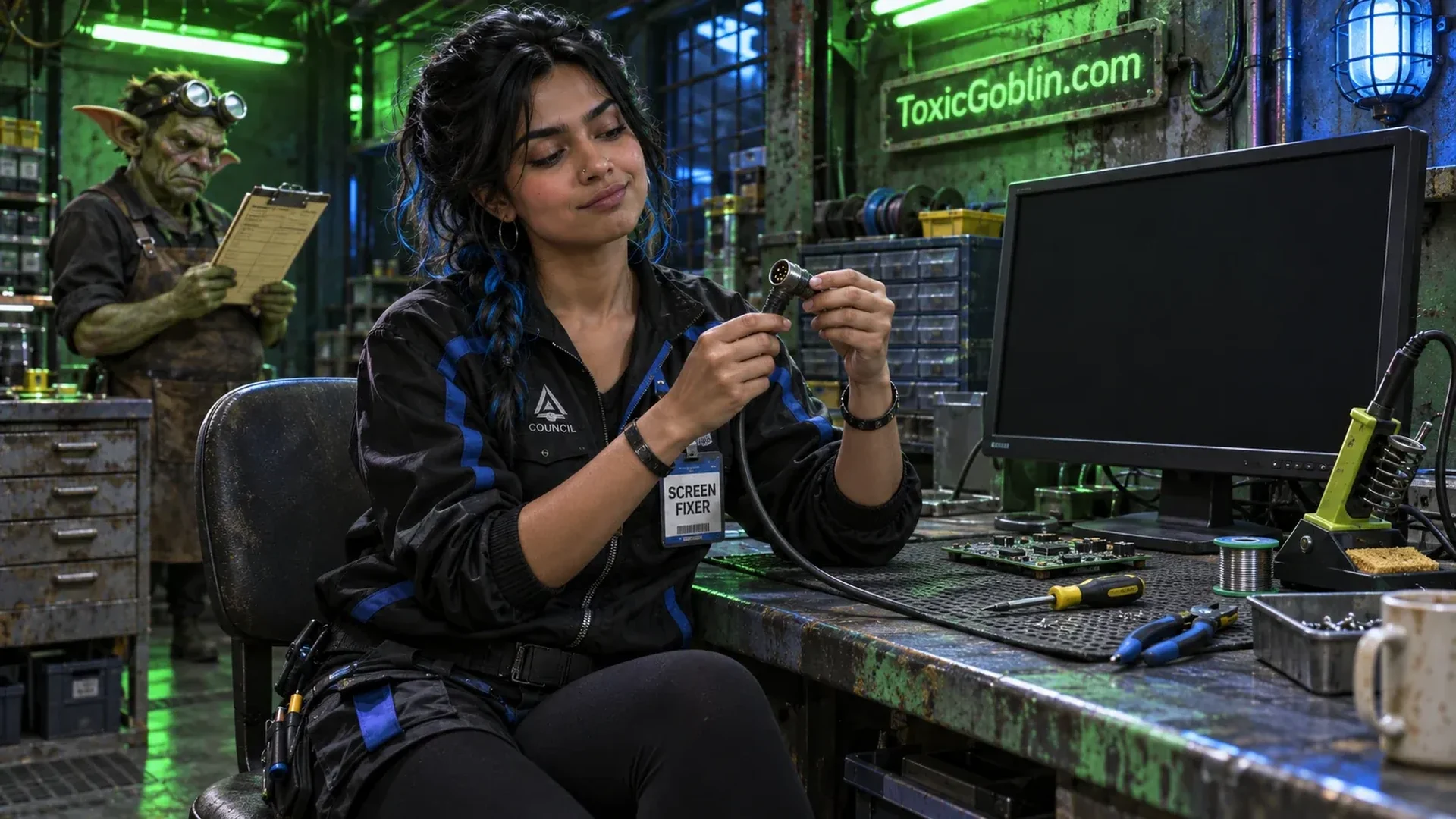
On screen, Nikki Neon had already fixed the fault. She wore a clean jacket, held the correct tool and looked irritatingly rested. In the actual workshop, Nikki had misplaced the tool and wanted to go home.
An apparently flawless future keeps Nikki working the same shift until she accepts an unfinished repair.
Her future self tapped the display twice. The message beneath her read: DO EXACTLY THIS.
A prediction isn't a supervisor. Stop giving it my chair.
From the dossier
Prologue — Tomorrow Has Better Lighting
Nikki's job in the Adult Booth District was Viewing Booth Maintenance Attendant. She kept the screens lit, the shutters working and the rows of private rooms from developing individual electrical opinions. What customers chose to watch was outside her assignment. Tonight every display showed a Council-approved landscape: a hillside with one improbably punctual sunrise.
The Goblin Council knew Nikki because she had repaired its announcement screen during a speech without pretending the speech needed to continue. Nikki knew which councillors complained about delays and which ones produced them. She kept different pockets for their repair requests, but neither pocket emptied.
Her latest order concerned booth Nine. It displayed a black square in the middle of the sunrise. Replacement parts were unavailable until the Council's clock declared the next business day. Unfortunately, that clock had stopped.
Nikki hated waiting on anyone else's competence. She preferred to finish a job alone, even when help would have made it easier. Dependence felt like a fault she ought to be able to isolate.
When her own face appeared on the faulty screen, she first assumed a practical joke. Then the pictured Nikki lifted a little blue connector she had never seen and placed it beside a component that did not yet exist in the real cabinet.
The screen displayed a drawer number.
She opened the drawer. The connector lay inside, wrapped in a repair ticket dated tomorrow. It bore her signature. Under the signature was a note: YOU ALREADY KNOW THIS WORKS.
Beyond the workshop, the Council clock clicked once.
Nikki set her cold tea aside. For the first time that evening, the job looked like something she could finish without asking anybody for anything.
Act 1
A Shift with a Seam
Act I — A Shift with a Seam
She followed the silent demonstration. The pictured Nikki moved with maddening efficiency, turning components that arranged themselves differently whenever the camera angle changed. These were not ordinary repairs. The cabinet contained a small wheel of pale light, and the blue connector joined its rim to a shadow cast by nothing.
When Nikki completed the sequence, the black square disappeared. The hillside filled the screen. A bell rang at the district entrance.
She picked up her bag.
Her tea was hot again.
Nikki stared at the cup. A goblin porter entered carrying a repair request for booth Nine. He delivered the same sentence he had spoken at the start of her shift, including the same cough in the middle. The Council clock pointed to the same minute.
The screen showed her future self, rested and clean, tapping twice.
Nikki checked the connector. It was back in its wrapper inside the drawer. Her jacket sleeve, which she had torn against the cabinet, was whole. The cut edge of the repair ticket had repaired itself too.
She performed the sequence again, faster. The square vanished. The bell rang. Her tea steamed.
On the third attempt she left a screwdriver under the cup. It returned to its rack. On the fourth she wrote a rude word on her wrist. It vanished with the rest of the shift. On the fifth she shouted at the screen before doing anything else.
Her future self smiled with the expression Nikki used when someone else had failed to read the instructions.
The porter returned. She stopped him before his cough and asked what he remembered.
“Delivering this.”
“Before that?”
“Being about to deliver it.”
He looked past her at the corridor, suddenly unwilling to go back into it.
Nikki had treated the repeating shift as a personal inconvenience. Watching him hold the same request with both hands, she understood that her successful repair was keeping other people here too.
Act 2
The Colleague Who Hadn't Happened
Act II — The Colleague Who Hadn't Happened
Nikki brought the porter into the workshop. His name was Brindle. She had known him through dozens of deliveries without learning it, a fact the loop gave her ample time to regret.
They watched the future display together. Brindle noticed something she had missed. The pictured room had no second chair. The rack held only Nikki's tools. There were no delivery trays and no door behind the cabinet.
It was a workshop designed for somebody who never needed another person.

The future Nikki wrote on a board: REMOVE DISTRACTION.
Brindle looked at himself. “Charming.”
Nikki did not send him away.
Instead she asked him to move the spare chair into the centre of the room. On screen, her future self paused. A faint outline appeared where the chair should have been, then vanished. The black square returned, larger than before.
The display was not showing a future already settled. It was offering the one future in which Nikki solved everything alone, then pulling the present back whenever reality disagreed with the demonstration.
That explanation did not tell her how to leave.
She considered smashing the screen. Her future self held up a hammer before she reached for one. In the display, broken glass reassembled. The cabinet became whole. Even rebellion could be included if she performed it alone.
Brindle suggested walking out without repairing the fault. Nikki heard herself listing reasons this was impossible: service standards, the Council order, her own promise that nothing left her bench unfinished.
“Which one locks the door?” he asked.
She looked. The workshop door was open.
Beyond it, every screen repeated the perfect sunrise. Every little hill waited for light that had already arrived. Nikki realized she had not checked the district clock since the first repair. She had accepted the screen's definition of completion and built an entire prison out of it.
She took the spare chair to the doorway.
For once she planned to leave a job visibly incomplete. She wanted a witness, and Brindle had earned a seat.
Act 3
One Dead Square
Act III — One Dead Square
The future Nikki changed tactics. She displayed a repaired Council clock, then a promotion letter, then a workshop with Nikki's name above the entrance. Each image stayed just long enough to make refusal uncomfortable.
Nikki carried her bag into the corridor. Brindle followed with the chair.
The screen offered an image of the porter safely outside. Nikki stopped. The pictured Brindle stood beneath the district arch, smiling. The real Brindle frowned at the screen.
“I've never owned that hat.”
It was a small error. It mattered because Nikki had not been able to imagine that the future could know less than someone standing beside her.
She handed Brindle the repair ticket. “Would you mark this unfinished?”
“You could do it.”
“Yes.”
He wrote the word slowly. Nikki left the black square on the screen and walked through the district doors without waiting for the successful-repair bell.
Behind them, the Council clock advanced.
Morning was grey, wet and late. Nikki had never liked it more. Brindle kept the chair until she pointed out that they would both be carrying it back the next evening.
The Council summoned her over the unresolved fault. Its members knew her well enough to recognize an excuse she would normally despise: she had chosen to stop working. She explained the loop. They requested proof from the screen.
Nikki declined to restart it for their convenience.
Her service record gained a black mark that looked remarkably like the dead square. The district lost its immaculate sunrise and received an ordinary clock display instead. Brindle began taking his tea in the workshop, where the second chair no longer looked temporary.
The dead square remained in booth Nine. Nikki covered the rest of the display with a plain service notice, leaving the fault visible instead of dressing it as a temporary improvement.
During her next break, Brindle carried their cups into the corridor. On the uncovered square, a tiny version of the workshop appeared. Its door was open now. The future Nikki sat at a second chair, waiting for somebody outside the picture.
Brindle asked whether they should watch until the visitor arrived. Nikki wanted to. She wanted very badly to know which future they had made possible by leaving the first one unfinished.
They took their tea outside. Behind them, from a workshop too small to enter, a chair scraped across the floor. Nikki kept walking, with Brindle beside her and the visitor still unseen.
A maintenance workshop outside its own timetable
Nikki’s story stays at the maintenance bench, with landscape screens, service tickets and an unreliable clock. Its invented machinery turns professional self-reliance into a repeating shift that affects the porter as much as the technician.