

Xenoverse origins / R-050
Tawny TokensOrigin story
Tawny Tokens and the Coin She Couldn't Spend
A Token Machine Technician collects coins containing possible outcomes and risks losing the ability to make a decision that is genuinely her own.
Read the origin ↓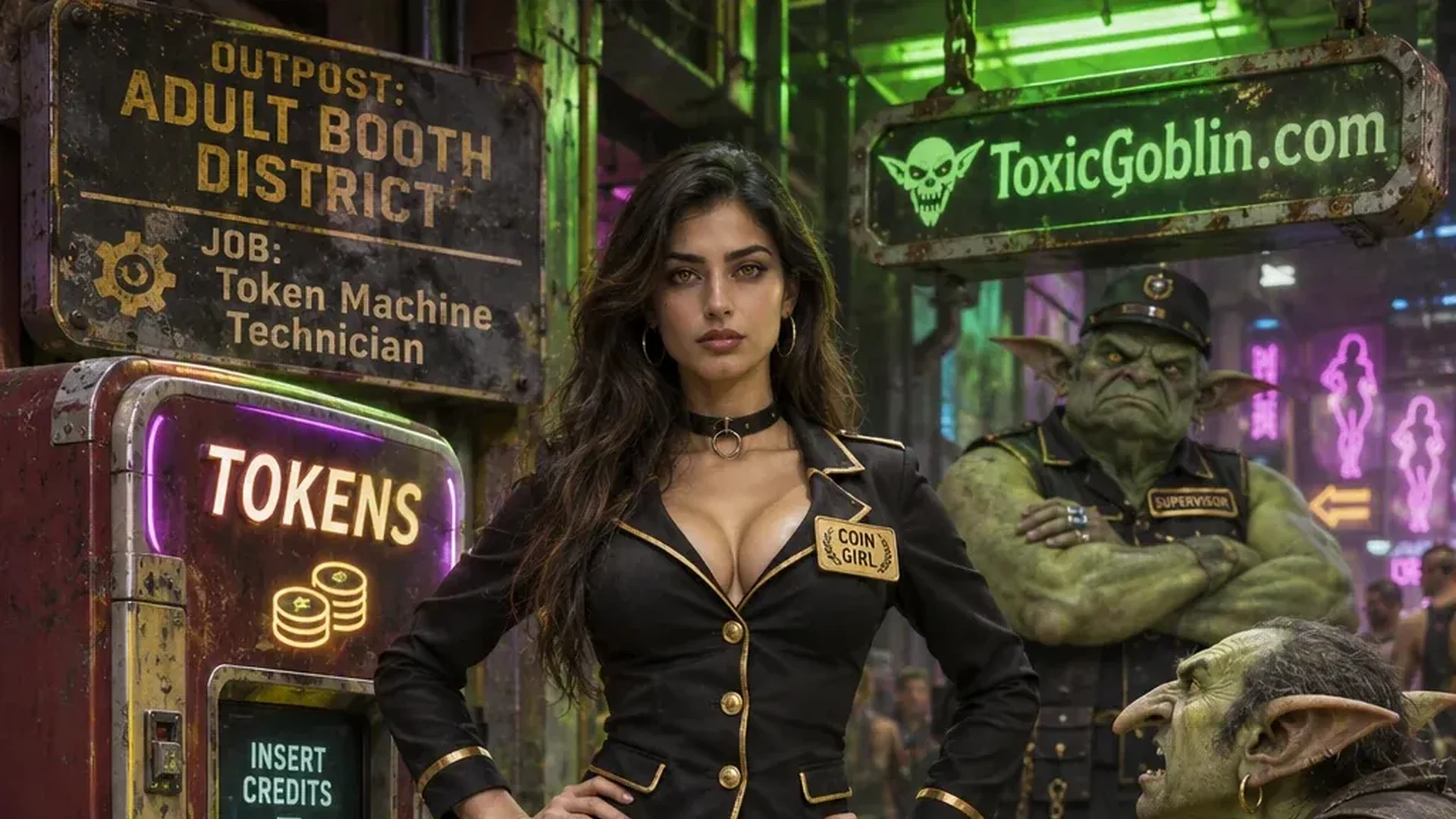
The unusual coin was warm. On one side, Tawny Tokens saw herself behind an impressive desk. On the other, she saw the same desk being carried away.
Tawny’s eye for a favourable exchange turns a curious dispenser into a private negotiation over her future.
She kept it. A person should investigate both sides of an opportunity.
Exact change is a terrible thing to ask from a life.
From the dossier
Prologue — A Small Private Collection
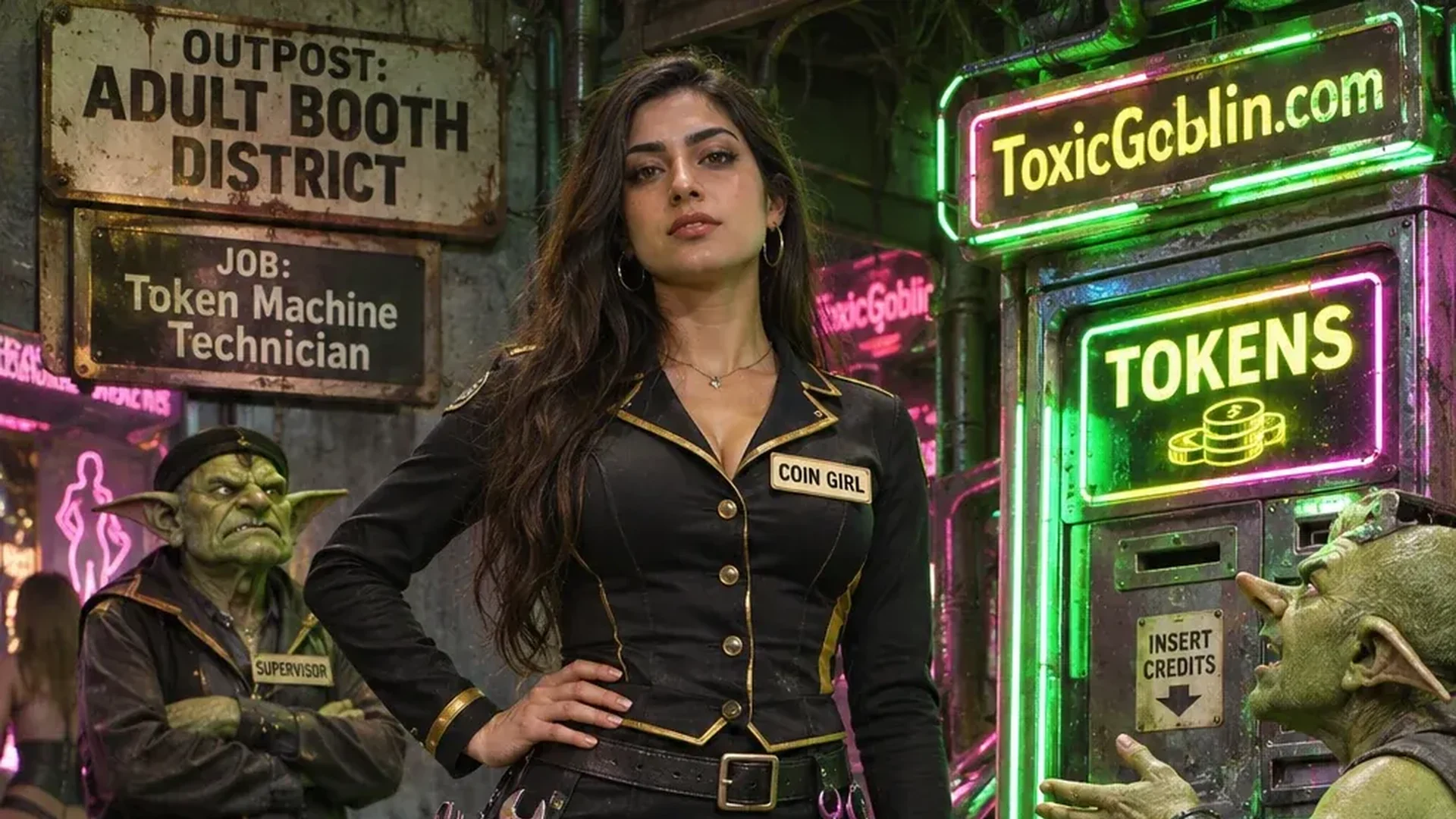
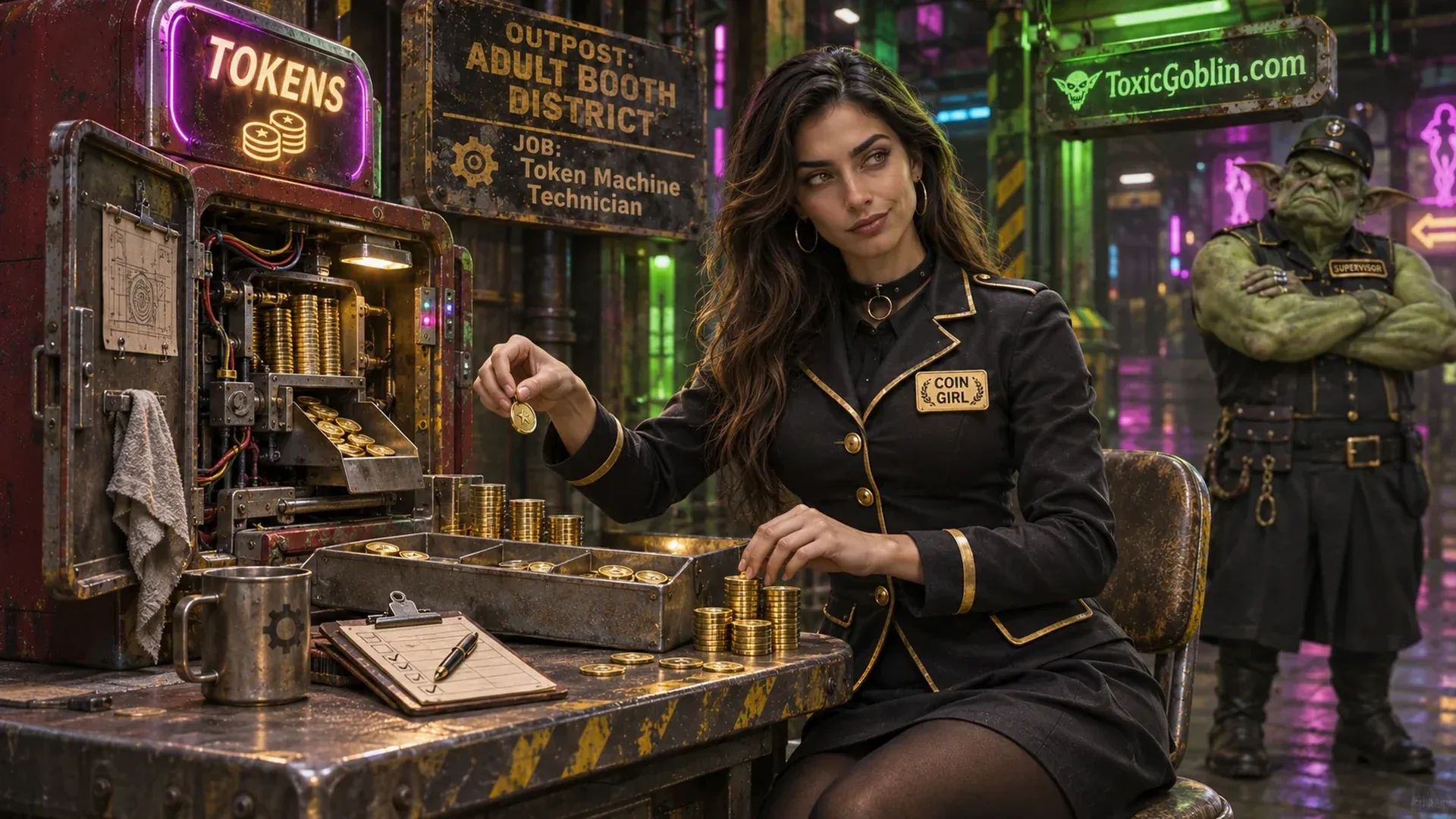
As Token Machine Technician in the Adult Booth District, Tawny spent her shifts recovering objects people insisted were money. Buttons, washers, ceremonial badges and once a very small dinner plate had all entered the dispensers. She kept the most ambitious examples in a drawer marked RESEARCH.
The Goblin Council knew about the drawer. Its treasury delegate had contributed the dinner plate, then attempted to claim an exemption from embarrassment. Tawny knew he would rather finance a new dispenser than retrieve it in public. Their familiarity gave her bargaining room she enjoyed using.
She liked a bargain more than she liked the thing it bought. A favourable exchange proved she had seen an angle someone else had missed. Unfortunately, she sometimes continued negotiating after she had already received what she needed.
Machine Seventeen arrived with no maker's plate and an instruction slot instead of a coin slot. Its cabinet was narrow, brass-edged and warm to the touch. When Tawny opened it, she found no mechanism she could remove. Inside was a descending staircase too small for her finger.
A bell rang somewhere below.
The machine dispensed the coin with the desk. Tawny turned it under the workshop lamp. The scenes moved. In one, a Council delegate shook her hand. In the other, she stood in an empty office holding a dead plant.
She placed a plain district token into the return tray. The machine swallowed it and printed a message: A MODEST BEGINNING. WHAT ELSE MIGHT YOU OFFER?
Tawny should have called a colleague. Instead she locked the workshop door, took out her research drawer and laid its strange little collection on the bench.
She had never encountered a machine that appreciated negotiation. It seemed rude to interrupt its first attempt.
Act 1
Terms Worth Considering
Act I — Terms Worth Considering
The dispenser rejected the buttons and accepted the dinner plate. A second coin appeared. On one face, Tawny walked away from the district carrying a full purse. On the reverse, she sat in an unfamiliar station unable to remember where she had intended to go.
She laughed. “You're selling guesses.”
The machine printed: SO ARE MOST EMPLOYERS.
Tawny warmed to it.
She asked what it wanted for the office coin's favourable outcome. The reply arrived slowly: YOUR CERTAINTY THAT THE UNFAVOURABLE ONE CANNOT HAPPEN.
That sounded like something she did not possess anyway. She accepted.
The coin turned bright. Somewhere in the district, a messenger began walking toward her workshop with an appointment offer. Tawny could hear his footsteps as clearly as if the wall were a sheet of paper.
She asked for a better offer.
The machine took her certainty that she would recognize a bad one.
The messenger's footsteps divided. Tawny heard two sets approaching from opposite directions. Her desk coin displayed two chairs. The full-purse coin showed two stations. She could still choose, she thought; she simply had more information now.
A knock interrupted the bargaining. The treasury delegate stood outside with a sealed invitation to discuss a promotion. Behind him waited another goblin holding an almost identical envelope.
Both used her name. Both had impeccable Council seals. Both looked mildly insulted by the existence of the other.
Tawny read the first invitation. It was excellent. She read the second. It was also excellent. When she returned to the first, the words had become impossible to distinguish from a trap.
Inside the cabinet, the tiny bell rang.
The delegate asked which meeting she preferred. Tawny opened her mouth and discovered that every answer arrived with an equally persuasive reason not to give it.
For the first time in her working life, an advantage had made her less capable.
Act 2
The Price of Being Sure
Act II — The Price of Being Sure
She sent both messengers away with instructions to return later. This was a choice, but a temporary one, and temporary decisions still belonged to her. She clung to that distinction while the machine printed a fresh proposal.
RESTORATION AVAILABLE. ALL OUTCOMES MUST BE RETURNED.
Tawny put the office coin in the tray. Nothing happened. She added the travel coin. The machine returned both, polished.
“What else?”
The staircase inside the cabinet lit up. Along its tiny landings stood versions of Tawny she had not noticed: one wearing the badge from the desk scene, another carrying the purse, another standing empty-handed. They watched her through the open panel.
The machine had not sold pictures. It had borrowed the beginnings of lives she might live. Each bargain made those beginnings more definite, until letting one go felt like dismissing a person who already knew her.
The empty-handed version raised its face.
Tawny shut the panel. She could negotiate over her own disappointment. This was harder.
The treasury delegate returned alone, impatient and without his invitation. He had left it in a carriage that might or might not have belonged to him. He asked whether she had recovered his dinner plate.
She expected an argument. Instead she found herself explaining the machine.
He listened with the concentration he normally reserved for other people's valuables. “Can it produce a future in which the Council has no unpaid expenses?”
“Probably.”
“What would it cost?”
“That question is how I got here.”
He suggested destroying the cabinet and keeping the coins. Tawny pictured the little stairwell collapsing. She refused. He suggested accepting every offer. She pointed to the two invitations, now lying on the bench with their words running into each other.
He finally asked what she had wanted before the machine arrived.
Tawny almost said promotion. Then she remembered the ordinary repair ticket, her half-finished tea and the drawer she liked showing to people who understood a good joke.
“I wanted to know how it worked,” she said. “I didn't need it to work for me.”
Act 3
A Future with No Guarantee
Act III — A Future with No Guarantee
Tawny opened the panel again. The little figures waited on their landings. She addressed the empty-handed one because it seemed least likely to promise anything.
“What happens if I stop choosing between your offers?”
The figure shrugged. The gesture was so recognizably hers that Tawny felt an unexpected rush of affection.
The machine printed: UNMANAGED OUTCOME. NO WARRANTY.
There was the future she had not tried to buy.
She took the dinner plate from the research drawer's empty space in her memory. It was not physically there, but she could still describe why she had kept it: a powerful goblin had been ridiculous, and she had enjoyed having proof. That pleasure had been hers before she traded it.
She told the machine it could keep the plate. She wanted neither the promised desk nor the guaranteed purse. She would accept the possibility of regretting her refusal without purchasing protection against regret.
The coins dulled. The little versions of Tawny turned toward the staircase and began descending. They did not look pleased. She resisted the urge to call them back and improve the terms.
The cabinet cooled.
Her decision did not restore everything. Both promotion invitations vanished. She could no longer picture the office without remembering the people she had almost become. The next ordinary choice took effort: tea now, or after finishing the repair report? She made it, then lived through the small uncertainty without consulting a coin.
The Council delegate filed the machine as an unsuitable acquisition. Tawny returned it to storage herself. She kept the research drawer, although the space left by the dinner plate bothered her more than she expected.
Several shifts later, a messenger brought a plain envelope with no seal. Inside lay a dull coin bearing neither face nor picture.
The enclosed note was written in her hand: I TOOK THE OFFICE. WE SHOULD TALK.
Tawny put the coin on the bench instead of in the drawer. She made tea for one, left a second cup within reach and waited to learn whether an invitation could remain an invitation without becoming another bargain.
The technician and the price of certainty
Token machines make the district’s transactions look simple. Tawny’s impossible cabinet complicates that work by offering outcomes instead of currency, forcing her to distinguish a useful choice from a promise she can no longer question.