

Xenoverse origins / R-054
Felicity FreakshowOrigin story
Felicity Freakshow and the Ordinary Emergency
A Human Curiosity Exhibit Host falsely claims she can recognize a perfect stranger and must build an honest performance from the failure of her own publicity.
Read the origin ↓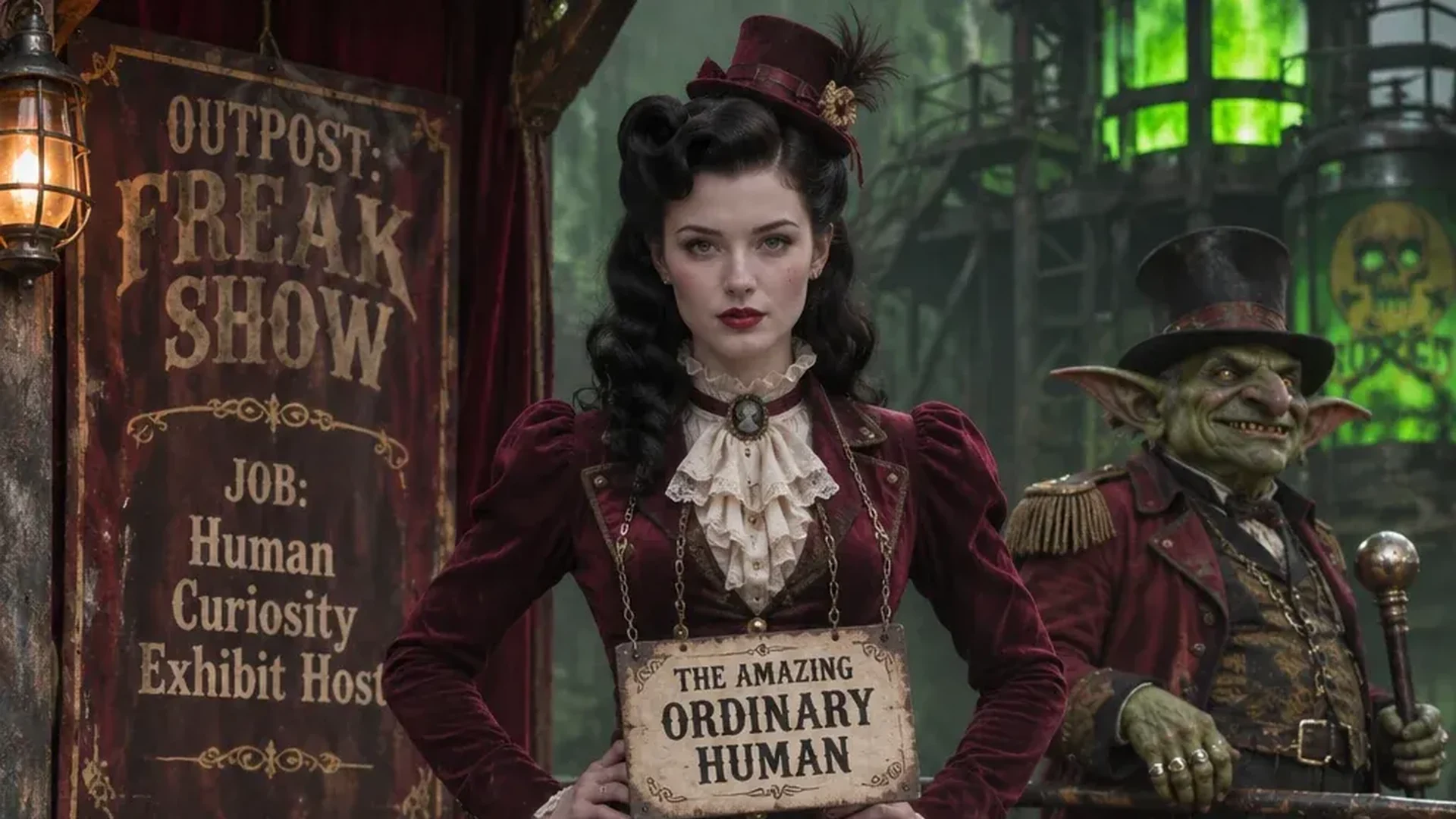
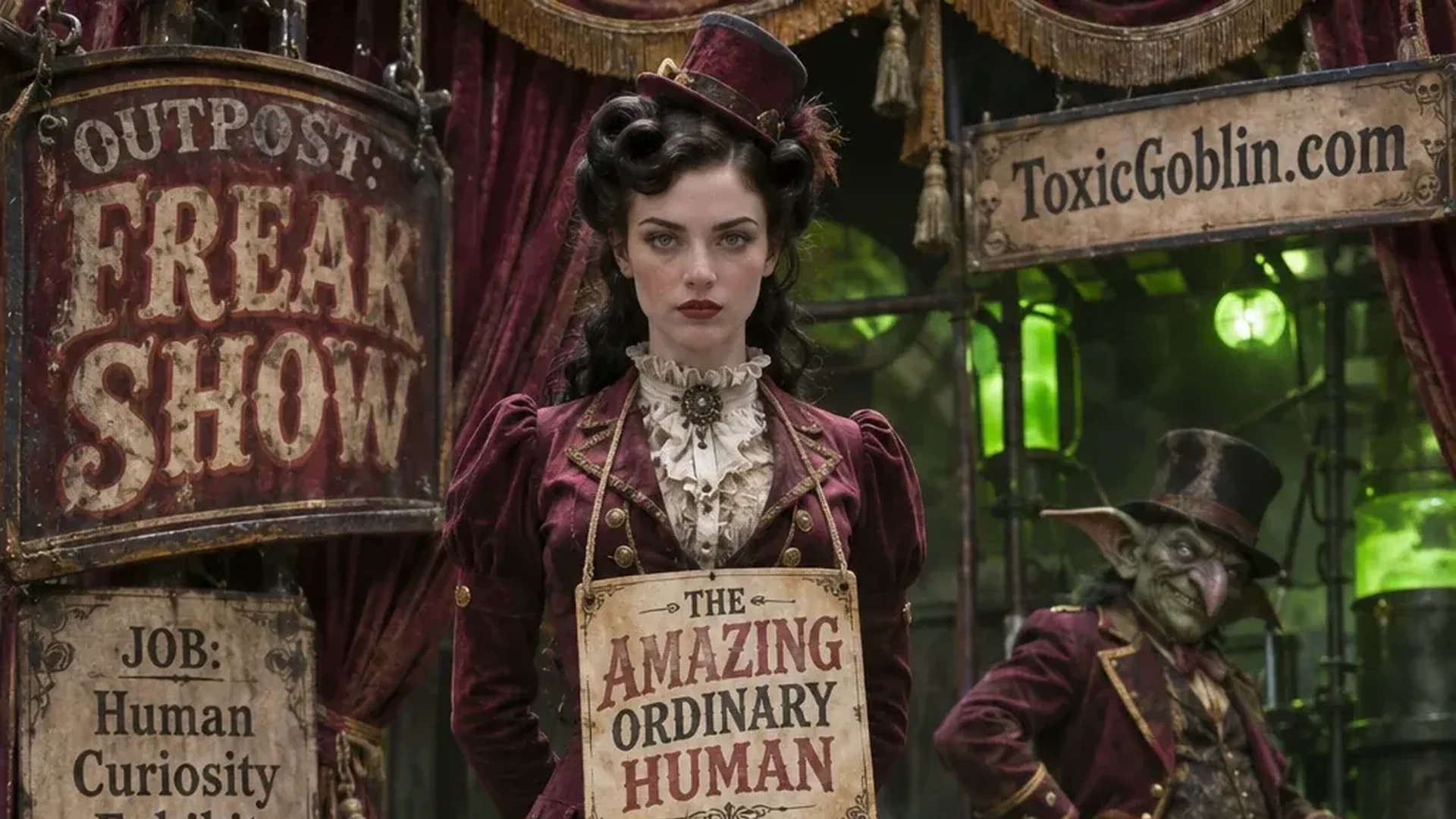
The sign promised THE AMAZING ORDINARY HUMAN. Felicity Freakshow objected to the adjective placement.
An empty exhibit tempts Felicity into advertising a talent that a stranger refuses to help her fake.
On a wet afternoon with three empty performances behind her, she decided to make the sign more interesting. She had a brush, excellent handwriting and far too much time to consider herself overlooked.
You paid to see a human. You brought the impossible part.
From the dossier
Prologue — A Talent for Being Present
At the Freak Show, Felicity served as Human Curiosity Exhibit Host. She stood on a small stage, introduced the exhibit and answered questions that ranged from earnest to deliberately foolish. Some visitors assumed ordinary meant easy to explain. Others assumed amazing entitled them to a refund if she merely continued existing.
The Goblin Council knew her by name. She had argued before its entertainments committee about the height of her stage and won a second step, which the committee counted as a substantial investment in her future. Felicity knew they judged the success of an exhibit by how difficult it was to walk past the queue.
Recently, walking past hers had become effortless.
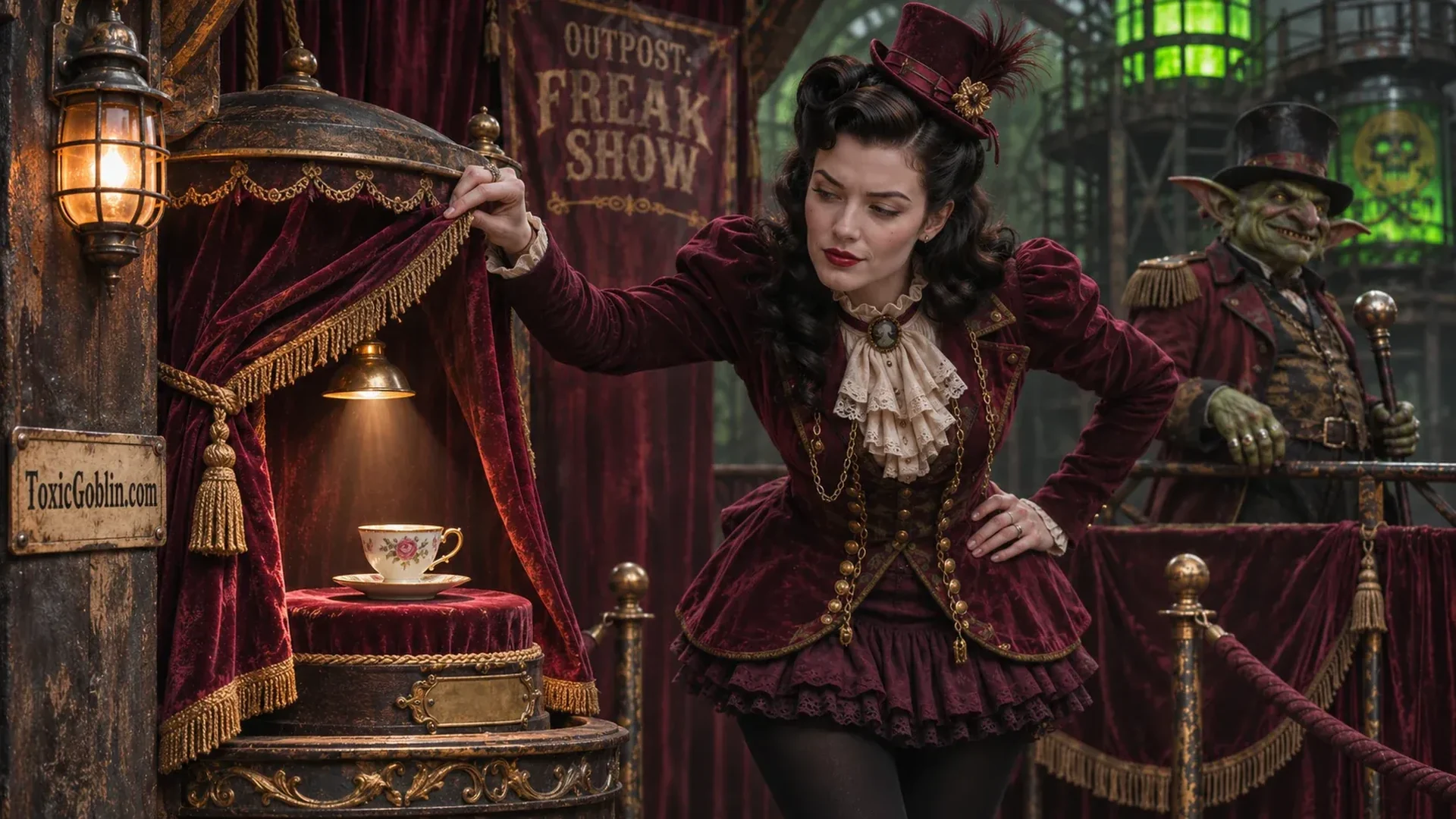
She tried changes that remained within her contract. A sharper introduction. Better lighting. A demonstration of making tea while answering questions. The tea attracted more interest than she did, and a refreshments clerk asked whether she could move her stage farther from his stall.
Felicity was proud of her timing, her diction and her ability to make a plain sentence sound worth listening to. She was also vain enough to consider boredom an insult somebody must be directing at her.
The brush waited beside the sign.
Under its existing promise she added: WITNESS THE HUMAN WHO WILL RECOGNIZE A PERFECT STRANGER.
It was meant as a joke about how strangers became acquaintances. She could explain that elegantly once they were inside. She imagined a little pause, then appreciative laughter.
By closing, a queue reached the main path.
A Council steward arrived carrying a sealed audience challenge. He congratulated Felicity on finally finding a talent relevant to the price of admission.
She looked at the sign. In her careful lettering, the joke had acquired the weight of a guarantee.
The steward booked the Council's central box. Felicity accepted before asking what the challenge contained.
Act 1
The Man Nobody Knew
Act I — The Man Nobody Knew
The following evening, a goblin in an unremarkable grey coat waited behind the stage. He had been selected, the steward said, precisely because nobody in the exhibit staff knew him. His pockets had been checked for identifying objects. He wore no badge.
Felicity asked whether she might speak to him privately. The steward said that would compromise the demonstration.
“Then how am I supposed to recognize him?”
The steward looked delighted. “That's what the audience wants to know.”
She could cancel. The refunds would consume her recent earnings, and the Council would remember that its second step had supported a failure. She could confess that the sign described a conversation rather than a talent. That was the honest choice. It was also the one her pride kept moving to the end of the list.
Instead she asked the grey-coated visitor to help her create an impression. A nod at the right moment, a brief expression of surprise. She would supply the words. He would leave with part of the evening's proceeds.
“What would you say about me?” he asked.
“Something broad enough to be true.”
“To whom?”
She disliked the question because it had an answer she could hear herself avoiding.
The visitor declined her offer. He had come because the sign promised recognition. He wanted to know what she would recognize without being told.
On stage, the audience waited beneath warm lamps. Felicity introduced the demonstration with more confidence than it deserved. The Council members leaned forward. She brought the visitor into the light.
She studied his coat, his hands and his patient face. Every useful detail had been removed or could mean several things. She could invent a grief, a trade, a hidden ambition. The audience would help her turn a guess into a marvel if the stranger allowed it.
He stood very still.
Felicity heard her own breathing between sentences and realized she had invited a person onto the stage to use as a prop in an argument with empty seats.
Act 2
The Guess That Didn't Land
Act II — The Guess That Didn't Land
She made one attempt.
“You are accustomed to being overlooked,” she said.
The visitor considered this. “Sometimes. So are most people.”
A little laugh moved through the crowd. Felicity felt it strike exactly where she had meant to place a revelation.
“You came here seeking something you had lost.”
“No. I came because the sign said you could do this.”
The laugh grew sharper. The Council steward moved toward the foot of the stage, ready to describe the problem as a breach of performance terms.
Felicity could still accuse the stranger of obstructing the act. The audience might accept that too. She had seen performers rescue themselves by giving a crowd someone easier to blame.
She set her presentation bell on the floor.
“I can't recognize you,” she said. “I haven't met you.”
The visitor nodded. “That seems reasonable.”
The steward began to climb the second step. Felicity asked him to stop, and the audience, sensing a more interesting dispute, told him to let her continue.
She explained the sign's intended joke and the point at which she had decided to let people believe something grander. She did not call it a misunderstanding. The queue had flattered her, and she had kept the money.
Then she offered refunds.
The steward protested that this was not within the evening's budget. Felicity took the cash box from behind her lectern and placed it on the stage. That made the discussion wonderfully concrete.
Several visitors approached. Others stayed to watch what would happen after an exhibit host ran out of deception. Felicity found this attention less pleasant than applause, but considerably harder to mistake.
The grey-coated visitor asked whether he should leave.
She asked whether he wanted to.
He looked at the remaining audience. “I've never stood on a stage before.”
“What did you expect it to feel like?”
He considered the question seriously. For the first time that evening, Felicity waited without preparing a line to place over his answer.
“Warmer,” he said. “And less like being in everyone's way.”
Act 3
Someone Worth Meeting
Act III — Someone Worth Meeting
Felicity fetched a chair. The visitor sat while she remained standing beside the lectern. She asked his name. He gave it: Penn. She repeated it, and that was the first recognition she could honestly offer.
He repaired small hinges. He disliked being asked whether that was all he did. He had a habit of carrying spare screws in his pockets, which the steward had removed as suspicious personal objects. He worried that the steward would lose them.
The audience laughed differently this time. One visitor produced a faulty spectacle case. Penn refused to repair it during the performance. This earned the evening's first spontaneous applause.
Felicity asked him how to tell when a conversation had become an unpaid appointment.
“When they stop answering your questions,” he said, “and start explaining what you could do for them.”
She glanced at her sign and did not improve the moment with a joke.
By the end, she had refunded half the room. The remaining visitors stayed longer than any audience she had hosted that month. Nobody witnessed an impossible talent. Several left having disagreed about something ordinary, which gave them more to discuss on the path than the original promise would have.
The Council steward offered to commission a regular series: strangers, confessions, carefully selected surprises. He already had a title that made Felicity's apology sound like a successful trial.
She declined the proposed format. He removed her evening bonus and warned that empty seats would remain her responsibility.
Penn collected his screws. He told her he had enjoyed part of the evening and disliked another part. She thanked him for refusing to pretend otherwise.
The next day, Felicity painted over her extra promise. The old sign returned, with its irritating adjectives intact. She kept the second chair on stage, but did not put anyone in it simply because a chair needed filling.
At the next performance, one visitor entered.
Felicity felt disappointment arrive, familiar and immediate. She let it pass across her face before beginning. The visitor noticed.
“Am I not enough?” he asked.
She could have offered a polished reassurance. Instead she looked at the empty rows, then back at him.
“I don't know yet,” she said. “Shall we find out?”
She drew the curtain herself. Outside, the steward waited to count the applause.
Recognition on a very small stage
The Human Curiosity Exhibit turns ordinary conversation into public performance. Felicity’s dilemma concerns the difference between meeting a person and assigning them a role that makes a show work, with refunds and Council attendance keeping the pressure tangible.